In a minor after-hours panic tonight, I stumbled upon an interesting online expert locator service with a cool twist…instant access. 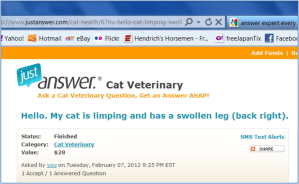
I needed cat health advice from my veterinarian, but realized her office is closed for the night, so I resorted to Googling “cat leg swollen” to see what could be going on. (Pause, while I acknowledge what you must be thinking — “She used the Internet to get veterinary care?”)
My Google search yielded, among thousands of other sites, www.JustAnswer.com. The site description promised:
Pet Experts are online, ready to answer your pet health questions about dogs, cats, horses, and other animals. … A new question is answered every 9 seconds.
Seeing few other choices than packing up my husband and my injured cat to go the emergency vet, I decided to take a chance. A few clicks later, and I’d promised to pay $28 to connect instantly to a licensed veterinarian, who would answer my question to my satisfaction, “or you don’t pay a cent.”
JustAnswer connected me to a vet immediately, whose rating scores showed an almost perfect record of over 4500 “positive” acceptances of her answers, with just a handful of neutral/negative responses. I typed my concern and question into the free text box, and within about a minute the online vet responded with a clarifying question and a general direction to consider.
I left this brief exchange with more than just a quick answer. She gave me enough clarity and peace of mind to last until I can take my cat to her regular vet tomorrow. I happily selected the “Accept Answer” button, and $28 bucks later, I’ll sleep well tonight. (I’ll resist calculating the cost-per-hour for this service, because the 8 hours of sleep I’ll get is worth every penny.)
Exploring the JustAnswer site, I learned that they have more than 100 categories of experts immediately available, from doctors to lawyers, to mechanics to electricians and more.
So, what do you think about this instant expert concept? How might you use it?
 Every learning leader has faced the dilemma of being asked to cram too much information into a training course because of a customer’s belief that “more information is better learning.” You know the drill, and it usually starts something like this, “Hey Jim, thanks for designing that course for us. I was thinking, we should also add…[insert 438 data points, factoids, and might-use administrivia here] to our course.”
 You know the job market has become increasingly competitive. A standard resume or CV won’t really cut it these days. To stand out, there are ever-more random lengths people will go to in order to secure a job or even get noticed by potential employers. Take a look at some of the best job applications around.

 Susan E. Hendrich