FLIP the Frustration: Avoid temptation to join the venting spiral

YOUR TEAM DOESN’T NEED ANOTHER PERSON TO COMPLAIN WITH.

They need someone who can help them move forward.

Imagine you’re leading a team of ten people. They’re frustrated. A new policy makes no sense to them. A decision feels unfair.

Everyone has an opinion. And you agree with them. So you sit down and say: “I KNOW! Can you believe they’re doing this?”

Congratulations. You just became the 11th rep. You’re no longer helping ten frustrated people navigate a difficult situation.

You’ve become the eleventh frustrated person, and now you’re making things worse.

Here’s a leadership lesson that’s hard to hear: Validation is not amplification.

You can acknowledge people’s feelings without fueling their frustration.

You can stand beside your team without getting stuck with them. And you can challenge decisions without turning your team into a complaint department.

That’s why we developed FLIP:

F — FACE the frustration without fueling it.

L — LISTEN to understand, not just respond.

I — INVITE people into the conversation and the solution.

P — PROGRESS toward constructive action.

Sometimes progress means moving forward with a difficult decision.

Sometimes it means challenging the decision itself. But it always means doing more than complaining.
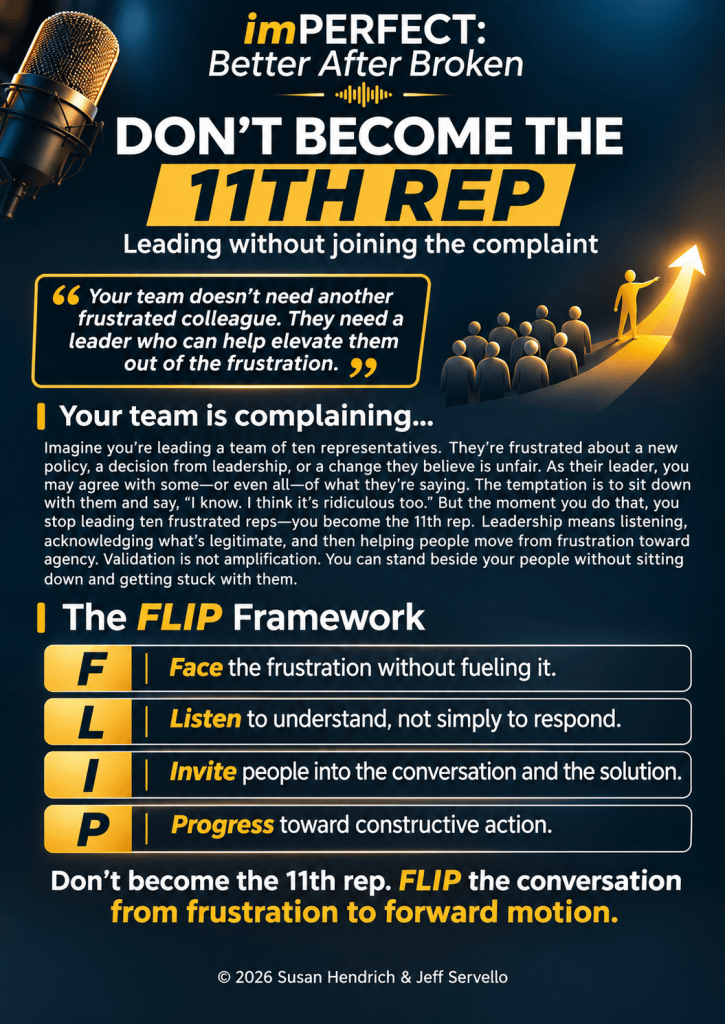
Infographic titled “Don’t Become the 11th Rep,” explaining the FLIP leadership framework for turning team frustration into constructive action.

On imPERFECT: Better After Broken, executive coach and leadership consultant Jeff Servello, PCC, RBLP-T, and clinical psychologist and executive coach Susan Hendrich, PsyD, explore the difference between empathy and enabling, validation and amplification, and being part of a team versus leading one.

Here’s our question for you:

Have you ever worked for a leader who became the 11th rep?

Or have you ever caught yourself doing it? We’d love to hear your experience. https://youtu.be/Ozm2tZgTMzA?si=zPyLVLWghiLByrxJ

🎙️ imPERFECT: Better After Broken #Leadership #FLIPFramework #LeadershipCoaching #EmotionalIntelligence #imPERFECT

When Care Becomes Control: LET THEM GROW

If your team can’t succeed without you, have you really empowered them?

It’s an uncomfortable question.

Many leaders genuinely believe they’re helping when they step in, correct the work, take over a decision, or prevent a mistake.

But good intentions don’t always produce good outcomes. Sometimes the leader becomes more indispensable while the team becomes less confident.

In our latest episode of imPERFECT: Better After Broken, executive coach and leadership consultant Jeff Servello, PCC, RBLP-T, and clinical psychologist and executive coach Susan E. Hendrich, PsyD, explore the difference between care and control—and why creating the conditions for success matters more than controlling every step.

We talk about psychological safety, productive struggle, clear expectations, the anxiety underneath micromanagement, and the courage it takes to let someone learn.

A question worth asking yourself this week: Who’s getting stronger because of my leadership—me or the people I lead?

Watch the conversation, follow imPERFECT for more practical leadership insights, and share it with a leader who believes in developing others.

#LeadershipDevelopment #ExecutiveCoaching #Empowerment #LeadershipEffectiveness #imPERFECTPodcast

What You Carry: The Invisible Load

What are you carrying that nobody at work can see?

We talk a lot about workload. Meetings. Deadlines. Emails. Expectations.

But we don’t talk nearly enough about “the load.” Grief. Caregiving. Health concerns. Financial stress. Relationship strain. Parenting. Uncertainty.

The emotional weight of being the person everyone else turns to.

And leadership can add another layer: you’re carrying your own backpack while people are handing you pieces of theirs.

In this episode of imPERFECT: Better After Broken, executive coach and leadership consultant Jeff Servello PCC, RBLP-T, and clinical psychologist and executive coach Susan Hendrich, PsyD, explore what happens when workload sits on top of everything else we’re carrying.

We talk about the difference between being busy and burdened, the hidden emotional labor of leadership, why capable people often become very good at appearing fine, and how to care about people without absorbing what belongs to them. We also revisit the powerful Cleveland Clinic video, “Empathy: The Human Connection to Patient Care,” and the reminder behind it: we see people’s behavior, but we rarely know the whole story behind it.

So instead of immediately asking, “What’s wrong with this person?” What if we asked: “What might this person be carrying?” Compassion doesn’t mean lowering standards. Empathy isn’t the absence of accountability.

Understanding someone’s context can change how we enter the conversation while still being clear about what matters. And there’s another person whose load deserves our attention: ourselves. What are you carrying quietly? What has gotten heavier lately? Where might you need support? And what are you pretending is fine that isn’t?

NEW EPISODE: The Invisible Load of Leadership: What You’re Carrying That Nobody Sees.

Because nobody walks into work empty-handed.

Watch on YouTube: @imPERFECTBetterAfterBroken

#imPERFECT #Leadership #ExecutiveCoaching #LeadershipDevelopment #Empathy #EmotionalLabor #WorkplaceCulture #InvisibleLoad

Welcome to imPERFECT: Better After Broken

imPERFECT: Better After Broken, with hosts Jeff Servello & Susan Hendrich.

Welcome to the premiere episode of the new radio podcast, imPERFECT: Better After Broken. Join us Sundays at 6 pm ET on Sandcastle Radio, America’s Hottest Online Variety & Music Station.

Hosts Jeff Servello and Dr. Susan Hendrich share raw stories of repair, resilience, and what it takes to rebuild stronger. This is a conversation about breaking, healing, and coming back with more clarity, more courage, and more purpose.

Sometimes the break is the breakthrough. And, your best may still be ahead.

Learn more: https://www.youtube.com/watch?v=e9ucyjznc7M&t=1121s

#imPERFECT

Getting Unstuck: Install Your Mental Pause Button

When you feel stuck, it’s rarely because you lack options.
It’s because your nervous system is running the show.

That’s where the mental Pause Button comes in.

Think of the mental pause Button as a built-in pattern interrupter—a way to stop the stress loop, create space, and choose a better response. Not later. In the moment.

The Pause Button isn’t about calming down for calm’s sake.
It’s about regaining agency.

When you hit an internal wall and don’t know what to do next, the Button helps you shift energy, interrupt autopilot, and move forward differently.

The Pause Button Method (3 Simple Steps)

Step 1: Install the Button

Close your eyes for 10 seconds and imagine installing a physical pause button in your mind.

Make it yours:

  • Big or small
  • Blue, gold, red, sparkly
  • Subtle or bold

The design doesn’t matter.
The function does.

This button exists for one reason: to interrupt a stuck pattern.

Step 2: Assign It a Job

Your Button’s job is to stop emotional autopilot—fear, frustration, irritation, reactivity.

When you press it:

  • Emotions don’t disappear
  • They simply stop driving

You create a gap—and in that gap lives choice, perspective, and agility.

This is the moment you remember:

I’m not stuck. I can pivot.

Step 3: Pair It with New Language

Agility isn’t activated by force.
It’s activated by reframing.

Every time you press your Button, say this—out loud or silently:

“If this moment isn’t working, I’m allowed to change it.”

That one sentence gives you permission to pivot:

  • Mentally
  • Emotionally
  • Strategically

Now you’re back in the driver’s seat.

What Happens After You Pause

Once the stuck pattern is interrupted, ask better questions:

  • What else could be true?
  • What’s the next right move, not the perfect one?
  • Where is the opportunity inside this friction?
  • What version of me do I want leading right now?
  • If this were a chapter in my story, how do I want it to end?

You’re not rewriting the past.
You’re rewriting your response.

And that’s where leaders grow.

Stuckness wants you to believe there’s only one ending.
Agility reminds you: you’re the author, not the character.

So the next time you feel stuck—
Press the Button.
Pause the pattern.
Choose differently.

You are not stuck. not stuck.