Information is not the answer

Design experiences, not information

Every learning leader has faced the dilemma of being asked to cram too much information into a training course because of a customer’s belief that “more information is better learning.”  You know the drill, and it usually starts something like this, “Hey Jim, thanks for designing that course for us. I was thinking, we should also add…[insert 438 data points, factoids, and might-use administrivia here] to our course.” 

It’s the data dump. The fact frenzy. The overview overkill.  It’s just difficult sometimes for folks to believe that less information could lead to more (and better) learning. 

Well, today we’re going to make the case for shifting the focus away from information altogether. Here, designing guru Cathy Moore makes a powerfully simple case for shifting from designing information to designing experiences.

Can’t access YouTube? Here’s a Flash version.

Freebie fun: Create word clouds with Wordle

Wordle is one of the coolest free toys I’ve seen in a while.  I’ll let author  Jonathan Feinberg‘s  description speak for itself and get out your way so you can read it then start Wordling…

Wordle is a toy for generating “word clouds” from text that you provide. The clouds give greater prominence to words that appear more frequently in the source text. You can tweak your clouds with different fonts, layouts, and color schemes. The images you create with Wordle are yours to use however you like. You can print them out, or save them to the Wordle gallery to share with your friends.

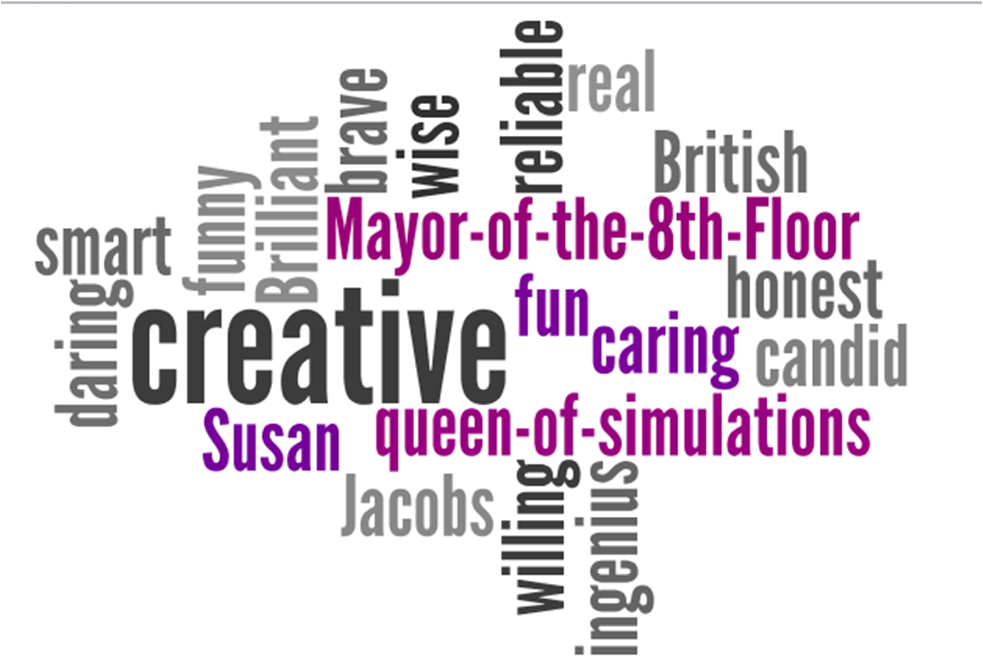
Here’s one I made for my colleague, Susan Jacobs, as a birthday surprise for her office door:

Wordle Cloud

So, what words will you use to create your own Wordle cloud?

Yammer Time

What is Yammer?

Yammer is a simple, scalable solution that lets employees share and connect with coworkers in a private, secure enterprise social network.  It’s like Twitter for your internal organization. Yammer is a tool for making companies and organizations more productive through the exchange of short frequent answers to one simple question: “What are you working on?”

Check out this quick, engaging and informative presentation on the What, Why and How of Yammer. Worth the 3 mintues it takes to view.

Free Learning Job Aid Toolkit

Are You On The Move! Yet?

The Move! toolkit contains over 50 ‘one page’ job-aids with involving methodologies in five distinct areas : Individual, Team and Organizational Development as well as Project Management and Instructional Design & Facilitation.  You can browse through all the tools here.  Tons of helpful resources, and best of all…they’re FREE.

A. INDIVIDUAL DEVELOPMENT TOOLS

Performance Management Process / Objective Setting SMARTT / Build-Up coaching session / GROW model for coaching / Coaching Styles / Constructive Feedback / Questioning & Listening / Behavior Wheel / ACHIEVE Model / Individual Development Plan / Checklist for effective coaching / Appraisal Interview /

B. TEAM DEVELOPMENT TOOLS

Team Work Model (GRPI) / GRPI Questionnaire / Action Centered Leadership (Adair) / Intervision / Meeting Management / Multi Voting / Brainstorming / Mind Mapping /Effective Decisions / SWOT Analysis / New Leader Expectation Activity / SADIE problem solving / SORA problem solving / Intake Teamdevelopment

C. ORGANIZATION DEVELOPMENT TOOLS

Consulting Process / Intervention Strategy / Business Needs Analysis / Stakeholder Analysis / Initial Customer Contact / Contracting Checklist / Force Field Analysis / Scenario Planning / SARAH coping with change / Change Loop / Balanced Scorecard / Community of Practice / Autonomous Motivation (Self-Determination Theory) / Confrontation Matrix / Environmental Scan

D. PROJECT MANAGEMENT TOOLS

Project Process Map / Project Planning (GANTT) / Critical Path Method / Cause & Effect Analysis (Ishikawa) / Impact – Effort analysis / Risk Analysis / Project Learning Review / Stakeholder Activities / Focus Groups / Individual Interviews / Data Analysis / Responsibility Matrix

E. INSTRUCTIONAL DESIGN TOOLS

8 Field Analysis (Kessels & Smit) / Learner focused versus content focused / Experiential Design model / Checklist Learning Activities / Types of Process Interventions / Guidelines for debriefing group activities / Involvement : look at training / Scenario Template / Statement Game / Checklist for instructional design / Learning Activities /

 

Hurray for brevity. Less IS more!

Want your learning audience to retain more and perform better?  Then lighten their cognitive load.

Cognitive load theory says that “the more a person has to learn in a shorter amount of time, the more difficult it is to process that information in working memory.” Add to this processing difficulty the fact that we retain less when overloaded with data, information, and concepts. The idea behind cognitive load theory is that reducing the volume of information to be learned to only the “need to know” level lets the learner retain more of the information and make the necessary transfer of learning to be able to perform a skill or task.   And that might just be a very good thing when it comes to designing training.

“By reducing the load on the cognitive system, summaries may enable students to carry out the cognitive processes necessary for meaningful learning.” 

From When Less Is More: Meaningful Learning From Visual and Verbal Summaries of Science Textbook Lessons, by Richard E. Mayer, William Bove, Alexandra Bryman, Rebecca Mars, and Lene Tapangco 

What does this mean about people’s desire and tolerance for information?

Twitter taught us that we’re in a sound bite zeitgeist. When it comes to information and learning, we want it short. Sweet. To the point. Quick. Rapid. Just the facts. Twitter? Yammer? What’s the matter?  

Despite growing research supporting this “less-is-more” notion, it can be hard for subject matter experts to let go of the urge to create an information dump when designing training. Experts sometimes get stuck in the mindset of, “more is more,” and struggle to see how presenting a more basic volume of information might lead to better learning. Parsing out the nice-to-know from the need-to-know is the great challenge of the instructional designer.  Having a little less-is-more research in the back pocket might just come in handy for the designer who’s trying to convince a subject matter expert to limiting content to the need-to-know level.

Check out Cathy Moore’s “Making Change” blog post about an early study that showed the positive impact of reducing the amount of text presented to a summary on the ability to retain and transfer learning.