Future-Proof Your Career: Core Skills You Need for 2030

What skills will you need to succeed five years from now? The future of work is rapidly evolving, and the World Economic Forum’s Future of Jobs Report 2025 highlights the crucial skills we need to thrive in 2030. According to the report, analytical thinking is the most sought-after skill, with 7 out of 10 companies considering it essential in 2025. But it doesn’t stop there. Resilience, flexibility, agility, leadership, and social influence are also crucial. What about Artificial Intelligence (AI) and big data? Yup, it’s no surprise that these elements of technological literacy will be in high demand. But among my favorites are creative thinking, curiosity, and lifelong learning, along with motivation and self-awareness. These are skills we can build today!
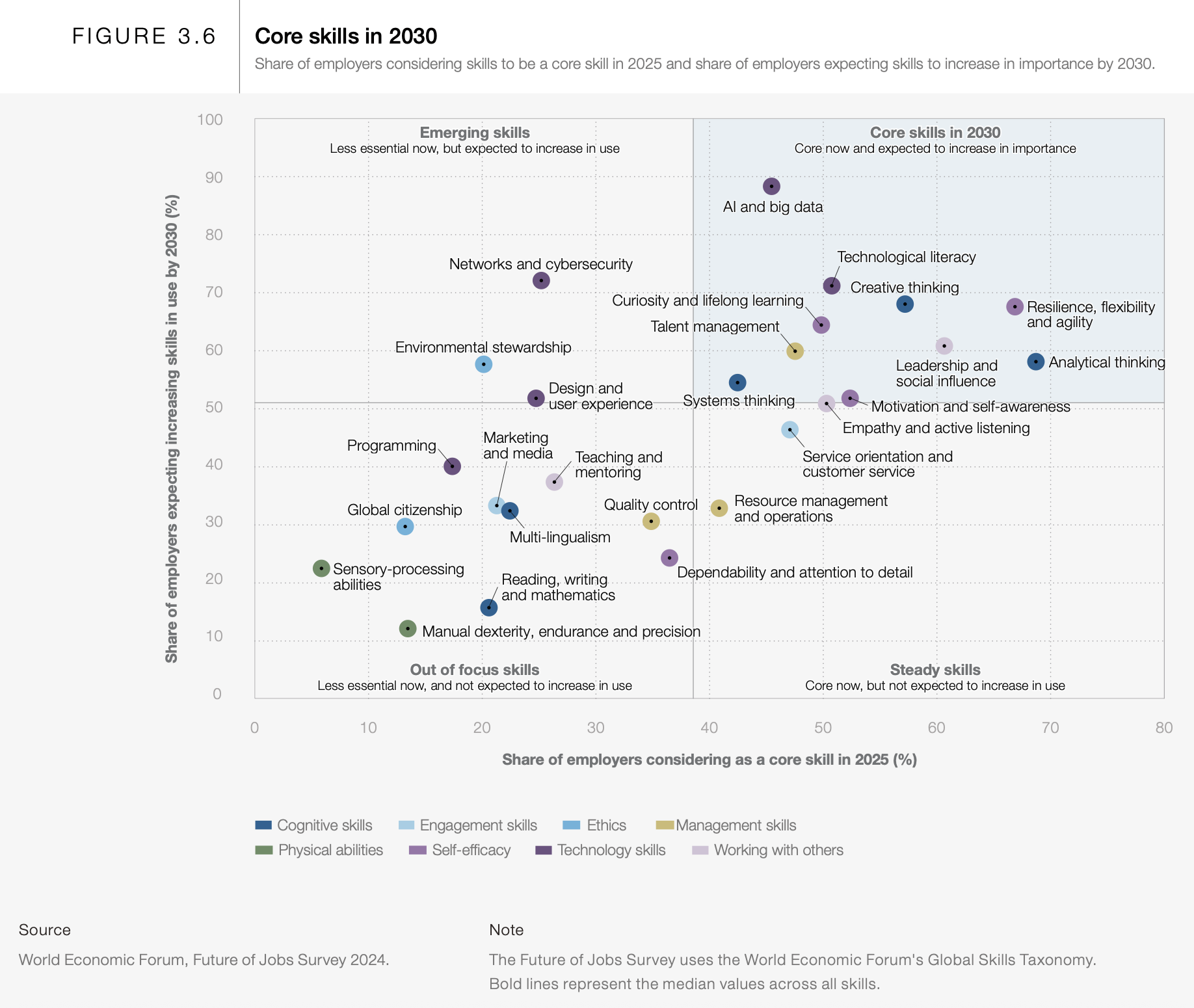
Let’s explore some of the top skills you’ll need to succeed:

  • Analytical Thinking: Sharpen your ability to evaluate information, solve complex problems, and make data-driven decisions.
  • Resilience, Flexibility, and Agility: Embrace change, adapt quickly to new situations, and bounce back from setbacks.
  • Leadership and Social Influence: Inspire and motivate others, communicate effectively, and build strong relationships.

These aren’t just buzzwords; they’re the keys to unlocking future opportunities. Invest in developing these skills today, and you’ll be well-prepared to navigate the changing landscape of work and achieve your career goals. Where can you go to learn? Try LinkedIn Learning.

#FutureofWork #Skills2030 #CareerDevelopment #WorldEconomicForum

Want to read on? Check out the Future of Jobs Report 2025

Thanks for joining me. Let’s keep the conversation going. Our future depends on it.

Join the Leadership | Learning | Innovation conversation at sashaphilosophy.com.


leadership elastic …now that’s fantastic!

Leadership Elastic …Now that’s Fantastic!

I love this article by WordPress blogger, LeadershipFreak:

Stretched, Not Crushed

Every time things start going wrong we look to the leader for solutions. Beware! The pressure to provide solutions crushes leaders. When solutions come from the top, organizations crumble from the bottom.

A C-level leader recently said, “When I wake up stressed out over problems in the night, I know I’ve forgotten it’s about the team. Things go better when I include others.”

Stretching others: Leaders who can’t ask people to do hard things can’t get hard things done. Meaningful contributions require deep commitment and effort. Weak leaders assume others can’t or won’t step up. They rule out before they ask.

Ruling out: That’s too hard for them. Making it easy prevents people from stepping up. Give people the opportunity to do hard things. I’m not suggesting you intentionally make things hard for others.

  1. They already contribute so much. Translation, they can’t make meaningful contribution in new areas.
  2. They wouldn’t be interested.
  3. They’re too valuable where they are. If anyone says that to you, update your resume’.

The big ask: The big ask is about values before programs. Programs, methods, and techniques are small things when compared with the power of shared values. Align shared values before making the big ask.

It’s the team:

Carrying the load alone crushes;
carrying the load together stretches.

Shared values are magnetic; they pull people together. Success is always about people before it’s about programs and initiatives. People committed to shared values make deep commitments to each other. Connections sustain and energize when things get hard. Blame separates and defeats.

How do you ask others to do hard things?

What should be in place before you ask for deep commitments?

via Stretched not Crushed, by LeadershipFreak

How do I save my video to my computer?

Here’s a Monday freebie for you…

A freeware program called KeepVid lets you save YouTube videos and other movie files to your computer.


Three easy steps to downloading videos:

1. Copy the URL of the video you want to download, then head to www.KeepVid.com, and paste it in the bar at the top.

2. Click “Download” to the right of that bar. Do not click the large green “Download” button.

 3. It will load for a few seconds, then you’ll have the option to download the video in FLV (Flash), MP4, or WebM format. If you don’t know which one to pick, go with MP4, as it has the greatest compatibility.

Here’s a nice tutorial on how to use KeepVid: http://howto.cnet.com/8301-11310_39-57405342-285/how-to-download-videos-from-youtube-vimeo-and-more/

Of course, be sure to have the appropriate permissions when saving videos.

Using technobabble to sound cool

Jargonicious! A plea for simplicity…

The ingenious (and totally fictitious) “Turbo Encabulator” video has long been used to warn against the use of technobabble. It has a fascinating history, which includes this Oscar-worthy 1977 performance by Bud Haggart:


What’s the lesson?

Avoid confusing jargon in your presentations.

Be conscious of your audience and sensitive to their familiarity with the terms that you use. We should use jargon, acronyms and other technical terms only if we are sure that our audience will understand them. If there is the slightest chance that they won’t understand, then simplify your language. Remember, if they can’t understand your message, they can’t adopt it.

I know what you’re thinking…

“But, Susan, big words make me sound more interesting and credible!”

Actually, the opposite is often true. The more clearly and simply you can deliver your message, the more likely people are to follow your ideas (intentional double entendre).

I would write more, but I’ve gotta go for now, as my flux capacitor needs recharging.

Your turn

Where have you seen (or even used) technobabble?

__________________________

Thanks to my colleague, Dave Ilconich, for reminding me of this classic video. 

Celebrate the spaces between

Let your ideas breathe…

How Can You Harness the Power of White Space?

Objects in a composition need to breathe. White space offers an airy canvas stage on which the parts of your design can freely dance. Just ask Mark Boulton, graphic designer and writer from the UK. Here’s my favorite part about Mark’s view on white space:

“Whitespace is often used to create a balanced, harmonious layout. One that just “feels” right. It can also take the reader on a journey through the design in the same way a photographer leaves “looking room” in a portrait shot by positioning the subject off the center of the frame and having them looking into the remaining space.”

Check out this slide show by Brand Autopsy to see some compelling use of white space.

Now, how can you use white space in your next design, web page, slide deck or thank you note to make a bold statement?

Looking forward to [the spaces between] your ideas,


Susan Hendrich