Future-Proof Your Career: Core Skills You Need for 2030

What skills will you need to succeed five years from now? The future of work is rapidly evolving, and the World Economic Forum’s Future of Jobs Report 2025 highlights the crucial skills we need to thrive in 2030. According to the report, analytical thinking is the most sought-after skill, with 7 out of 10 companies considering it essential in 2025. But it doesn’t stop there. Resilience, flexibility, agility, leadership, and social influence are also crucial. What about Artificial Intelligence (AI) and big data? Yup, it’s no surprise that these elements of technological literacy will be in high demand. But among my favorites are creative thinking, curiosity, and lifelong learning, along with motivation and self-awareness. These are skills we can build today!
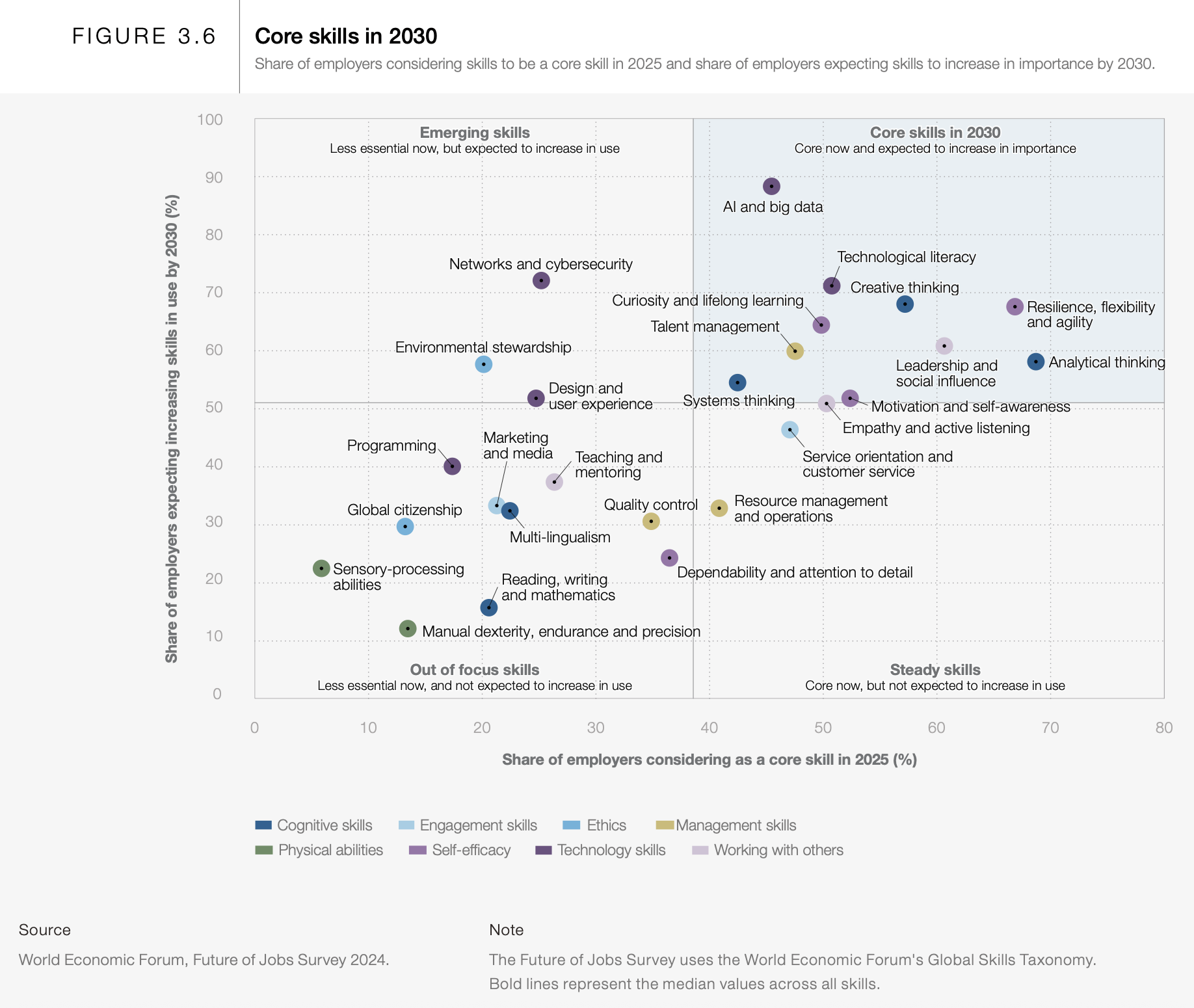
Let’s explore some of the top skills you’ll need to succeed:

  • Analytical Thinking: Sharpen your ability to evaluate information, solve complex problems, and make data-driven decisions.
  • Resilience, Flexibility, and Agility: Embrace change, adapt quickly to new situations, and bounce back from setbacks.
  • Leadership and Social Influence: Inspire and motivate others, communicate effectively, and build strong relationships.

These aren’t just buzzwords; they’re the keys to unlocking future opportunities. Invest in developing these skills today, and you’ll be well-prepared to navigate the changing landscape of work and achieve your career goals. Where can you go to learn? Try LinkedIn Learning.

#FutureofWork #Skills2030 #CareerDevelopment #WorldEconomicForum

Want to read on? Check out the Future of Jobs Report 2025

Thanks for joining me. Let’s keep the conversation going. Our future depends on it.

Join the Leadership | Learning | Innovation conversation at sashaphilosophy.com.

Change again? Good grief!

How Change is Like Grief

People experience different emotions when faced with change. Change can be viewed as a grieving process of sorts. Elisabeth Kubler-Ross described five stages of grief in her seminal work, ‘On Death and Dying’ in 1969.

The five stages include:

  • Denial
  • Anger
  • Bargaining
  • Depression
  • Acceptance (+ Moving On)

Kubler-Ross described the experiences of terminally ill patients and the psychological stages they go through when coming to terms with their condition. Her work on grieving process can be adapted to help us understand that individuals go through these same stages when faced with any big change, including changes at work.

Different Faces – Different Paces

Different people move through the stages at different speeds, and there may be some overlap between the stages. It is important for leaders to recognize this individual process. A person’s history, the organization’s history, the type of change and the consequence of change also impact an individual’s response to change and movement through the stages.

How Can Leaders Help Throughout The Stages?

Shock / Denial

  • Start communicating that there is a change early on. This minimizes the ‘Shock/Denial’ phase, as people will have begun to see that there is a need for change, even if they are unaware of the form that it will take.
  • When the change initiative is announced, give reasons that reduce complacency and highlight a need for change. Communicate in a way that is clear and touches people emotionally, not just with loads of data. Fully communicate the end vision of the change and what your intentions are.
  • Don’t try too hard to sell people on the idea that things are better for them; they are not ready to hear this.

Anger

  • Practice patience and empathy, and don’t try to suppress conflict. Provide a verbal outlet for people to vent their upset feelings. When leaders provide opportunities for grievances and frustrations to be aired constructively, bitterness and frustration can be diminished.
  • Although people will be angry that doesn’t mean that what they say has no value, they may have legitimate concerns that could affect the success of the change initiative.
  • Remember that  most likely, people are not attacking you personally. Remain calm and patient.
  • Often leaders have been made aware of a change initiative long before their teams, so although they may be at later stages (eg, be at “Acceptance/Moving on” while general staff are still at “Shock/Denial”).  Exercise patience.

Bargaining

When people start trying to bargain, ask them to give the new dispensation a chance. A lot of bargaining is done while people are still angry. Once the anger dissipates, so does much of the bargaining.

Acceptance

  • Help people acknowledge that it is the end of an era, support them in their new roles and encourage them to take responsibility. Set goals with them of which they can take ownership.
  • Continue your role as a sounding board for complaints and questions. Ask ‘How do you feel about this?’ to understand individuals’ emotional state.
  • Begin to stress the benefits of the new situation and how it can work for the individual.
  • If new teams were formed, provide help with group dynamics. People are generally less concerned with the tasks they are given than how they fit into a new group.
  • Plan for some early successes for the change initiative and then communicate them loudly. Once people can see that it is working then they will be less skeptical and more positive about the change.
  • Make sure the necessary resources are available for them to succeed, be it equipment or training or just coaching and guidance.

Moving On

Empower individuals to take the ball and run with it. Let them find ways of using the new set up to create stretch goals and encourage them to push performance.

Let employees innovate and take risks within the new set-up. Let them not only see ways of making the new system work in their favor but put those into practice.

For the individuals who really are taking the ball and running with it, reward them and promote them. Use them to show others what is possible. Having a fellow colleague really driving performance forward using the changes is worth far more than managers telling people things are/will be better. Once people can see it working for a colleague they will be far more receptive to the change.

_______________________________________

Your turn:

What “stage” of change are you leading through right now?

Stepping Away to Step Up: Why Renewal is Your Secret Weapon

Recharge and Refresh to Enhance Your Impact.

Life can be a whirlwind sometimes. Work deadlines loom, errands pile up, and suddenly it feels like you haven’t taken a real breath in days, weeks, even months. It’s during these times that I find myself craving renewal. Take a deep breath while you think about that word…renewal.

Now, renewal might not sound like the most exciting thing on the to-do list, but hear me out. It’s not about sitting in a bubble bath for thirty minutes (although that has its merits). It’s about consciously choosing to step away from the hamster wheel, even if it’s just for a little while, to come back feeling refreshed and ready to tackle anything.

Think about it. Have you ever tried to write a creative piece when your brain feels like mush? Or tried to have a productive conversation when you’re running on fumes? It rarely ends well. We need time to recharge, refocus, and reconnect with ourselves in order to truly thrive.

Here’s the thing, renewal doesn’t have to be a grand gesture. It can be as simple as:

  • Taking a walk in nature: Immersing yourself in the sights and sounds of the outdoors can be incredibly calming and restorative.
  • Putting your phone down and reading a book: Escaping into a good story can help you de-stress and gain new perspectives.
  • Trying a new recipe: Engaging in a creative activity can spark joy and get your creative juices flowing again.
  • Spending time with loved ones: Connecting with those closest to you provides a sense of belonging and support.

Even small changes to your routine can have a big impact. Instead of scrolling through social media before bed, try some light stretching or reading. Replace your usual commute with a scenic bike ride.

The key is to find what works for you and make it a priority. Remember, renewal isn’t selfish, it’s essential. It’s the key to maintaining your energy, creativity, and overall well-being. So next time you’re feeling burnt out, don’t push yourself further. Step away, recharge, and come back stronger than ever.

I’m heading outside now to breathe in the crisp February air and renew my focus for the week ahead. How will you RENEW?

Susan

p.s. Looking for a book to guide your journey? Check out: Renewal: How Nature Awakens Our Creativity, Compassion, and Joy by Andrés R Edwards

The 3Gs of Mentor Matchup: Goals, Gaps, Gifts

Goals, Gaps, and Gifts: Mentor / Mentee Matchup Magic

An ideal mentor/mentee matchup blends three key elements: Goals, Gaps, and Gifts.

GOALS: Mentor and mentee should have compatible goals and aspirations. For example, if your goal is to become a director, choose a mentor with experience as a director or other leadership role. If you aim to build confidence in delivering presentations, find a mentor who dazzles you when they are on the stage.

GAPS: A good mentor can fill in the gaps in the mentee’s knowledge and experience. For example, if you are new to the industry, choose a mentor who can teach you about the industry and help you develop skills.

GIFTS: Mentor and mentee should have complementary gifts and talents. For example, if you are a creative thinker, choose a mentor who is good at strategic planning and execution. Having complementary skills allows the mentee to see a different way of approaching novel situations.

Think about your own experience as a mentor or mentee. How did your goals, gaps, and gifts intersect?

Want more information? Check out the LinkedIn discussion, “How can you ensure that mentors and mentees are a good match?”

The Power of Perception

Perception can create a self-fulfilling prophecy. The classic leadership book, The One Minute Manager by Ken Blanchard and Spencer Johnson, shaped my leadership approach. They teach the power of Perception. Consider the story of The Monk and the Travellers:

THE MONK AND THE TRAVELLERS

One day a traveller was walking along a road on his journey from one village to another. As he walked he noticed a monk tending the ground in the fields beside the road. The monk said “Good day” to the traveller, and the traveller nodded to the monk. The traveller then turned to the monk and said “Excuse me, do you mind if I ask you a question?”. 

“Not at all,” replied the monk. 

“I am travelling from the village in the mountains to the village in the valley and I was wondering if you knew what it is like in the village in the valley?” 

“Tell me,” said the monk, “What was your experience of the village in the mountains?” 

“Dreadful,” replied the traveller, “to be honest I am glad to be away from there. I found the people most unwelcoming. When I first arrived I was greeted coldly. I was never made to feel part of the village no matter how hard I tried. The villagers keep very much to themselves, they don’t take kindly to strangers. So tell me, what can I expect in the village in the valley?” 

“I am sorry to tell you,” said the monk, “but I think your experience will be much the same there”. 

The traveller hung his head despondently and walked on. 

A while later another traveller was journeying down the same road and he also came upon the monk. 

“I’m going to the village in the valley,” said the second traveller, “Do you know what it is like?” 

“I do,” replied the monk “But first tell me – where have you come from?” 

“I’ve come from the village in the mountains.” 

“And how was that?” 

“It was a wonderful experience. I would have stayed if I could but I am committed to travelling on. I felt as though I was a member of the family in the village. The elders gave me much advice, the children laughed and joked with me and people were generally kind and generous. I am sad to have left there. It will always hold special memories for me. And what of the village in the valley?” he asked again. 

“I think you will find it much the same” replied the monk, “Good day to you”. 

“Good day and thank you,” the traveller replied, smiled, and journeyed on.

___________________

THE POWER OF PERCEPTION

Tell me how this story impacts you? Does your own perception of situations evolve based on the attitude you bring? Sure makes a difference for me. Choose wisely.