Courage and Resilience

Courage and Resilience: Inspiration from a Holocaust survivor

Holocaust survivor Morris Freschman allowed me a freedom I have never before experienced, and he inspired me to design Courage and Resilience, a project that began as a poster commemorating Morris and all Holocaust survivors, liberators, and righteous gentiles.

“You cannot keep a grudge; you cannot have hate because it destroys people. You have to forgive people or it will destroy you.” – Morris Freschman, Holocaust Survivor

CourageAndResilience_web.jpg

Meet Morris

Anyone who’s shopped the New Castle Farmers Market in Delaware may recall Freschies Deli, where Morris Freschman sold delicious fresh food for many years. He warmly greeted his customers with a twinkle in his eye and an infectious smile. Behind those sparkling eyes, Morris carries the memories of losing most of his family to murder, and suffering four horrific years of his youth in the concentration camps of Blechhammer (a satellite camp of Auschwitz), Gross-Rosen, and Buchenwald. Underneath the sleeve of his crisply ironed shirt, the number 177060 is emblazoned on his arm, tattooing more than just his survival, but his courage and resilience in the face of unimaginable suffering.

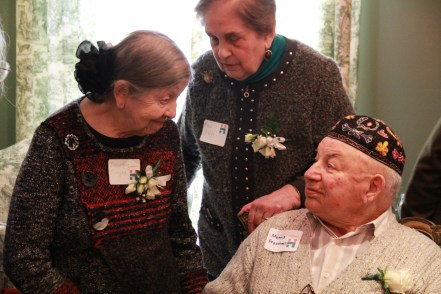
Morris was born in Sarnov, Poland on May 3, 1929 to David and Ida Freschman. David and Ida, along with all but one of Morris’ eight siblings, would perish along with millions in the Holocaust. Somehow, through a series of miracles, Morris survived. But it wasn’t until 2004 that Morris was able to speak publicly about his Holocaust experience, when he was interviewed by documentary producer Steve Gonser. In April 2016, I had the honor of meeting Morris and five other Holocaust survivors at the home of my parents’ friends, Roger and Danna Levy, where more than 60 people gathered to hear the stories of survivors, liberators and righteous gentiles through an excerpted screening of  the documentary No Denying: Delawareans Bear Witness to the Holocaust,” by filmmaker by Steve Gonzer on behalf of the Halina Wind Preston Holocaust Education Center.

Once the film snippets concluded, and with hesitation and heavy sighs, Morris stood among the crowd and spoke of his own times of courage and resistance. He shared five miracles that kept him alive during the Holocaust:

  • Miracle 1: The first miracle happened when Morris was ten years old and was forced along with his family to live in the Polish ghetto. Morris was working to smuggle food to his cousin’s store, and was hiding two packages of eggs in his shirt when a Gestapo policeman stopped him. When asked what he was carrying in his shirt, Morris replied “potatoes.” The policeman “smacked against my shirt and broke all the eggs.” A moment of terror. Morris bravely told the officer that if he would release him, Morris would have his cousin pay, but instead the officer took him to the police station. Morris knew that he would be executed on sight at the police station, as smuggling bore a death sentence. Just as they arrived at the station’s door, the Gestapo policeman kicked Morris hard and said he would come that night for the money, and released Morris.
  • Miracle 2: At age 12, Morris was taken by cattle car to Blechhammer. One of the Jewish overseers recognized Morris’ face and spared him by moving him to the line of those destined for labor camp, rather than being immediately killed. “Every day, you saw death. Everywhere you turned,” he said. “As a skinny 12 year-old kid torn from my family, I spent the rest of my days praying to live another hour or day. All of my energy was spent looking behind my back and trying not to become obvious to the guards, who would not hesitate to shoot you or send you to the gas chambers.”
  • Miracle 3: In June of 1944, Morris was an inmate working at a chemical plant. As allies bombed the plant Morris and 14 other boys tried to run to a bunker. The 14 other boys sneaked past the Germans who had at first forced them away, but Morris went into a sewer filled with human waste. Bombs killed all of the people in the bunker, but Morris survived.
  • Miracle 4: Somehow, Morris avoided being killed at Buchenwald during his four months there, where 85,000 people were murdered. That’s nearly the entire population of the city Wilmington, Delaware. All murdered at a single concentration camp between January and April of 1945. “They couldn’t burn the bodies fast enough,” Morris remembered. An African American Unit of the United States Army liberated Buchenwald on April 12, 1945 – the same day that President Roosevelt died. “The first American I ever saw – and I will never forget it – he was a 6-foot-4 black man. The joy when we were liberated, you cannot imagine.” Morris had spoken English, German and Polish, so the American liberators asked him to join them as an interpreter. After all he’d been through, Morris gladly enlisted and served a year in a Medical Army Surgical Hospital (MASH) unit with the United State Army.
  • “As for the other miracle? What are you ladies doing tonight?” Morris asked, and the room erupted with laughter.

How Morris Impacted Me

Amazingly, at 87 years old and with all he suffered among the worst of human atrocities, Morris carries his sparkly spirit to this day. “So, how does a person who has been through so much, have still so much to give?” I asked myself, sensing that it was time for me to change.

My prior exposure to World War II history was academic – focusing on the suffering and the numbers of the masses. Rarely did I connect to the individual lives of those impacted. I’d read Elie Wiesel’s “Night” several times in high school and college, but somehow maintained a scholarly distance from any emotional impact. I simply could not fathom that such things could happen to people – my people. Instead, I distanced myself from a part of my own being. My Jewishness.

This April, for the first time in my life, thanks to Morris, I decided to own a part of myself that until now I had hidden. That day of Holocaust remembrance opened a channel of courage for me.

As a child of a mixed religion marriage, I’d clung to my mother’s Christianity both out of familiarity, and because my father was not religious and rarely spoke of his Jewish heritage. When I asked, he always seemed sad and said that his family never spoke of being Jewish and that they actively tried to “fit in” within the Brooklyn community where they lived during World War II and beyond. I internalized shame and fear associated with my Jewish side. Stories of Jews being persecuted in the Bible, coupled with witnessing anti-Semitism in my early schooling, made me fearful of acknowledging my Jewish heritage. I recognized my avoidance as a form of cowardice, but rationalized it as being a product of the society in which I live.

Shame. Fear. Sadness. Disbelief. Anger…Emotions I was avoiding. Hearing Morris speak of these same emotions as part of his Holocaust experience, I connected the freedoms I enjoy today as an American citizen with the Courage and Resilience shown by Morris and so many others like him, who refused to be silenced even in the face of death. In that moment of insight and realizing how small my fears are compared to what Morris had suffered, I made a pledge to learn about and embrace my own family’s Jewish history. Writing this article is part of that pledge, however small or inconsequential it may seem.

I now have begun to research my Jewish heritage, thanks in part to Morris’ courage, and to the resilience of those who survived, those who liberated, and those who righteously stood up for Holocaust victims’ survival, dignity and honor.

I hope you enjoy this poster, and thank you for taking time to read my story.

Susan E. Hendrich


Sources

  • Personal interview with Morris Freschman, April 3, 2016.


Rebuilding after you crumble

IT’S NEVER TOO LATE.

So you blew it. You missed the deadline at work. You forgot your anniversary at home. You skipped the networking opportunity to meet your hero. You didn’t start that novel. You said words you now regret. It feels awful.

NeverTooLateNow what?

It is easy to fall into self-pity and retreat from being your best self after a defeat. After all, you just showed that you’re not perfect. You’re exposed.

That self-pitying retreat can spiral into a self-fulfilling cycle where you start to believe you can’t perform, then you reinforce that belief with further mistakes. More missed opportunities.

But you’re reading this article now for a reason. Maybe something about the word “Rebuilding” in the title triggered a resilience button in your brain. You’re here! And that means you’ve already started thinking about putting the pieces back together. Go, You!

But how?

You’ve made your mistake, and you’ve acknowledged it to yourself. That’s a great start. Now, go do something about it. Something constructive. Something positive. Something restorative. Anything that makes an incremental step toward rebuilding your confidence. Your relationship. Your reputation.

It may sound obvious, but the only way to regain positive momentum is to move forward. And moving forward requires a letting go of the past. Letting go, no matter how painful, how embarrassing, how derailing your blunder was.

You can REBUILD

Here are mental re-sets to help you make an incremental step toward rebuilding:

  1. Reinvent: Think about people you know who have reinvented themselves. Doesn’t everybody love a good comeback? Be the comeback kid in your own story.
  2. Evoke past resilience: Think about a time when you’ve bounced back from a failure. How did you do it? Well, then you can do it again? Even if this time was big-time.
  3. Bring help: No winner ever won by being completely alone. Find someone you trust and talk to them about your experience. I’ll bet they’ll share their own foibles and make you smile.
  4. Underdog yourself: Think about yourself as an underdog. Become your own champion. Champion of the underdog you’ve become. Who doesn’t like to see the underdog get the win?
  5. Imagine your next win: Think about what it will feel like to get your next win. Remember that even the best baseball players strike out more than 50% of the time. Every whiff is one swing closer to your next hit.
  6. Let it go: Use your favorite relaxation technique to release the uncomfortable feelings associated with your mistake.
  7. Do something different: Engage your brain, body and soul in a new activity as a way of demonstrating that you are not limited to your past behavior. Choose a positive action to counter the disappointment you feel.

As long as you are still standing (which I know you are, since you’re still with me here,) you have an opportunity to rebuild.

Let’s get to it!

Your Turn…

Leave a comment to make your statement about rebuilding.

_____________________________________________________________

image

About Dr. Hendrich

During two decades of leading teams toward extraordinary results in health care, pharmaceutical, arts & cultural, university and military organizations, Susan Hendrich has always been inspired by the stories of people achieving uncommon results through perseverance, positivity and prying opportunity from challenge. Susan’s mantra is “ganbatte kudasai,“ which means, “Always try your best.”


One for Hope

Night Walk in Thistles

Night Walk in Thistles – Acyrlic on board, by Susan Hendrich

A Poem on the Power of Hope.

Once there was a brilliant mind
Not frightened by the wind
It carried peace and married time
With plans to dance and sing

Along came feedback, helpful words
Just meant to shape a truth
Yet lost among the sharpened tongues
The precious freedom, youth

Becoming scared and running fast
This hope had lost its way
Too much of outside voices ring
Hunter became its prey

Now shed a tear once in a while
For heavy headed loss
But rise again, go find that wind
Fly with the albatross

One meant to swim and dance and play
Shall not be lost another day
As long as hope, that fire within
Is brave enough to rise again

Go find that place, make refuge there
The truth is yours, none other share
Your song, your hope
If only dared

_______________

image

About Dr. Hendrich

During two decades of leading teams toward extraordinary results in health care, pharmaceutical, arts & cultural, university and military organizations, Susan Hendrich has always been inspired by the stories of people achieving uncommon results through perseverence, positivity and prying opportunity from challenge. Susan’s mantra is “ganbatte kudasai,“ which means, “Always try your best.”