When you feel stuck, it’s rarely because you lack options. It’s because your nervous system is running the show.
That’s where the mental Pause Button comes in.
Think of the mental pause Button as a built-in pattern interrupter—a way to stop the stress loop, create space, and choose a better response. Not later. In the moment.
The Pause Button isn’t about calming down for calm’s sake. It’s about regaining agency.
When you hit an internal wall and don’t know what to do next, the Button helps you shift energy, interrupt autopilot, and move forward differently.
The Pause Button Method (3 Simple Steps)
Step 1: Install the Button
Close your eyes for 10 seconds and imagine installing a physical pause button in your mind.
Make it yours:
Big or small
Blue, gold, red, sparkly
Subtle or bold
The design doesn’t matter. The function does.
This button exists for one reason: to interrupt a stuck pattern.
Step 2: Assign It a Job
Your Button’s job is to stop emotional autopilot—fear, frustration, irritation, reactivity.
When you press it:
Emotions don’t disappear
They simply stop driving
You create a gap—and in that gap lives choice, perspective, and agility.
This is the moment you remember:
I’m not stuck. I can pivot.
Step 3: Pair It with New Language
Agility isn’t activated by force. It’s activated by reframing.
Every time you press your Button, say this—out loud or silently:
“If this moment isn’t working, I’m allowed to change it.”
That one sentence gives you permission to pivot:
Mentally
Emotionally
Strategically
Now you’re back in the driver’s seat.
What Happens After You Pause
Once the stuck pattern is interrupted, ask better questions:
What else could be true?
What’s the next right move, not the perfect one?
Where is the opportunity inside this friction?
What version of me do I want leading right now?
If this were a chapter in my story, how do I want it to end?
You’re not rewriting the past. You’re rewriting your response.
And that’s where leaders grow.
Stuckness wants you to believe there’s only one ending. Agility reminds you: you’re the author, not the character.
So the next time you feel stuck— Press the Button. Pause the pattern. Choose differently.
Seven powerful coaching questions to unlock excellence. Let’s discuss. This isn’t just about managing people; it’s about a skill crucial for leadership and personal growth. It’s a skill you and I both need.
In a discussion today with a colleague, I revisited a book that profoundly shifted my perspective on leadership and development: “The Coaching Habit” by Michael Bungay Stanier. It’s not just a good read; it’s a foundational text that unveils the simplicity and profound impact of effective questioning. Michael lays out a framework of seven deceptively simple yet powerful questions. What struck me, and what I believe is a core truth for all leaders, is this: Everyone is a coach.
Whether you lead a large organization, mentor a small team, or simply aim to guide a friend through a tough spot, the essence of coaching is invaluable. It’s about empowering others to find their own solutions, fostering autonomy and resilience. So, let’s dive into Michael’s framework, a practical guide for unlocking potential in yourself and those around you.
The Seven Essential Coaching Questions
1. “What’s on your mind?”
This is your Kickstart Question. It’s designed to bypass superficial pleasantries and dive straight into what truly occupies someone’s attention. It’s an invitation to share what’s exciting them, causing anxiety, or consuming their focus. As leaders, moving beyond small talk directly signals that you value their time and their most pressing concerns.
2. “And what else?”
Don’t underestimate the power of this Awe Question. Its simplicity belies its critical role. It serves two vital purposes:
It pushes past the initial, often superficial, response to uncover what’s genuinely at stake.
It prevents us from jumping prematurely into problem-solving mode, keeping the conversation in a crucial discovery phase.
The first thought shared is rarely the most significant. This question acts as a continuous probe, digging deeper to reveal the true underlying issues.
3. “What’s the real challenge here for you?”
This is the Focus Question, and it’s transformative. The emphasis on “real challenge” ensures we address the core issue, not just a symptom. The addition of “for you” brings the focus directly back to the individual. As a leader, you can only coach the person in front of you. This question helps them internalize the problem, preventing them from externalizing blame and encouraging personal accountability.
4. “What do you want?”
The Foundation Question clarifies the desired outcome. Asking “what do you want?” is an act of empowerment, creating psychological safety and granting autonomy. It also marks a critical pivot from reflection to action. Effective coaching facilitates progress, and clear desired outcomes are the first step toward achieving them.
5. “How can I help?”
I refer to this as the Lazy Question, but it’s anything but passive. It’s a strategic move for two key reasons:
It places ownership on the other person for the next steps, fostering self-reliance.
It prevents you from assuming you know the best course of action.
Just as “and what else?” curbs premature advice, “how can I help?” stops us from jumping into action before the true request is clear. Once a request is made, your response options are clear: “Yes,” “No,” “Perhaps, but differently,” or “Let me consider that.” The goal is clarity, not automatic obligation.
6. “If you’re saying yes to this, what are you saying no to?”
This is the Strategic Question, crucial for fostering focus and prioritization. Resources—time, attention, energy—are finite. Every “yes” inherently requires a “no.” This question forces a commitment, not just to what they will do, but to what they will not.
Consider both the “no of omission” (options automatically excluded by a choice) and the “no of commission” (what must be actively set aside—be it projects, habits, or old beliefs—to fully commit to the “yes”). A true “yes” demands the clarity of boundaries.
7. “What was most useful for you?”
Finally, the Learning Question. Genuine learning doesn’t happen just by doing or telling; it’s solidified through recall and reflection. Asking this question at the close of a coaching conversation creates a vital learning moment, reinforcing key insights and embedding “aha” moments. Leaders must create space for this reflection to ensure that learning sticks and translates into lasting change.
Embracing the Coaching Mindset
This framework offers a powerful sequence, though its application isn’t rigid. You might not use all questions, or perhaps not in this exact order. The underlying principle, however, is constant: the best way to help someone develop is by asking questions and empowering them to discover their own answers. This counter-intuitive approach—resisting the urge to advise—is the hallmark of truly impactful leadership.
Put these questions into practice this week. Observe the shifts, both in others and in yourself.
What profound questions have shaped your approach to leadership and coaching? I’d love to hear your insights.
Join the Leadership | Learning | Innovation conversation at sashaphilosophy.com.
Leading with SCARF: Cultivating Psychological Safety in the Workplace
We all crave connection, recognition, and a sense of control. These aren’t just nice-to-haves; they are fundamental human needs that significantly impact our well-being and performance, especially in the workplace. Dr. David Rock’s SCARF model brilliantly encapsulates these social drivers, highlighting five key domains that influence our behavior and motivation: Status, Certainty, Autonomy, Relatedness, and Fairness. When we question these five domains, we move to an Away State. When we have confidence in our Status, Certainty, Autonomy, Relatedness, and Fairness, we move to a Toward State.
Understanding and applying the SCARF model is not just good management practice; it’s a cornerstone of building psychological safety within teams and organizations. Psychological safety, the feeling of being able to speak up with ideas, questions, concerns, or even mistakes without fear of negative consequences, is crucial for fostering innovation, collaboration, and overall well-being.
Meet “Tox” – The Manager Who Created an Away State
Let’s see how SCARF can play out in the workplace. Meet “Tox,” a leader who wants to be seen as effective and inspiring, but unfortunately has a skewed perception of his helpfulness.
Imagine a project deadline looming. The team, already stretched thin, was working hard. Instead of offering support or clarity, Tox would frequently:
Threaten Status (in Tox’s mind: “Driving High Standards”): Tox would publicly point out errors in team meetings, believing he was “raising the bar” and ensuring quality. In his mind, saying things like, “Honestly, I expected better from someone at your level, we can’t afford mistakes like this,” was about pushing people to perform. He might have thought he was being direct and holding people accountable.
Undermine Certainty (in Tox’s mind: “Being Agile and Responsive”): Tox would change priorities and project scopes frequently, seeing it as being “flexible” and “responsive to the market.” In his view, sticking rigidly to a plan was a sign of being out of touch. Phrases like, “We need to pivot quickly to stay ahead,” were uttered with a sense of strategic urgency, even if it left the team feeling directionless.
Stifle Autonomy (in Tox’s mind: “Ensuring Quality and Efficiency”): Tox’s micromanagement stemmed from a belief that he knew the “best” way to do everything and that his oversight was crucial for preventing errors and maximizing efficiency. When rewriting work or dictating every step, he likely thought, “I’m just making sure this is done right and on time. I have the experience to guide them.”
Damage Relatedness (in Tox’s mind: “Fostering Competition and Meritocracy”): Tox’s tendency to play favorites and create a competitive atmosphere was likely seen as a way to “motivate” the team and reward high performers. He might have believed that a little internal competition would push everyone to excel, failing to see the resulting isolation and distrust. Comments like, “We need to see who the real performers are,” might have been intended to spark rivalry.
Act Unfairly (in Tox’s mind: “Recognizing Talent and Potential”): Tox’s arbitrary performance evaluations and rewards were likely justified in his mind as recognizing “talent” or “potential” that others might not see. He might have believed he had a unique insight into who was truly valuable, even if his criteria were opaque and inconsistent. Overlooking consistent performers might have been rationalized as those individuals “just doing their job.”
From Tox’s perspective, his actions weren’t meant to be harmful. He likely believed he was:
Demanding but fair.
Adaptable and strategic.
Providing necessary guidance.
Motivating and results-oriented.
Discerning and insightful in recognizing talent.
The tragedy of toxic leadership is often this disconnect between intent and impact. Tox’s behaviors, though perceived as helpful or effective in his own mind, still created a climate of fear, uncertainty, and resentment, directly undermining psychological safety and hindering the team’s ability to thrive. This highlights the critical need for self-awareness and the ability for leaders to understand how their actions are actually being received by their team, rather than relying on their own potentially distorted perception.
Tox needs help!
So, how might Tox leverage the SCARF model to create a psychologically safe environment? Let’s explore each domain:
1. Status: The Need to Feel Valued and Respected
The Threat: When individuals feel overlooked, criticized publicly, or their contributions are devalued, their sense of status is threatened. This can lead to defensiveness, withdrawal, and decreased engagement.
The Opportunity for Leaders: Leaders can enhance status by:
Recognizing and celebrating achievements: Acknowledge individual and team successes, highlighting specific contributions.
Providing constructive feedback thoughtfully: Focus on the work, not the person, and frame feedback as an opportunity for growth.
Actively listening to and valuing diverse perspectives: Ensure everyone feels their opinions are heard and considered.
Creating opportunities for growth and development: Investing in employees’ skills and career progression signals their value to the organization.
2. Certainty: The Desire for Predictability and Clarity
The Threat: Ambiguity, constant change without explanation, and a lack of clear expectations can trigger anxiety and a feeling of instability.
The Opportunity for Leaders: Leaders can foster certainty by:
Communicating clearly and transparently: Provide regular updates on organizational changes, goals, and expectations.
Establishing clear processes and guidelines: Predictable systems help individuals understand how things work and what is expected of them.
Providing context and rationale for decisions: Explaining the “why” behind changes helps people feel more informed and in control.
Being consistent in their actions and communication: Reliability builds trust and a sense of security.
3. Autonomy: The Urge for Control and Choice
The Threat: Feeling micromanaged, having no say in how work is done, or being constantly overruled can stifle motivation and create resentment.
The Opportunity for Leaders: Leaders can empower autonomy by:
Delegating effectively: Trusting individuals with responsibility and allowing them to own their work.
Providing choices and options: Where possible, give team members some control over how they approach tasks or projects.
Seeking input and involving others in decision-making: This fosters a sense of ownership and buy-in.
Encouraging experimentation and learning from mistakes: Creating a space where individuals feel safe to try new things without fear of punishment.
4. Relatedness: The Need for Connection and Belonging
The Threat: Feeling isolated, excluded, or working in an environment devoid of positive social interaction can be demotivating and detrimental to well-being.
The Opportunity for Leaders: Leaders can cultivate relatedness by:
Building strong teams: Encourage collaboration, communication, and social connections among team members.
Fostering an inclusive environment: Ensure everyone feels welcome, respected, and valued for their unique contributions.
Promoting empathy and understanding: Encourage team members to connect on a human level and support each other.
Creating opportunities for social interaction: This can be through team-building activities, informal gatherings, or simply encouraging open communication.
5. Fairness: The Desire for Justice and Equity
The Threat: Perceived unfairness in processes, rewards, or treatment can lead to resentment, distrust, and a breakdown of team cohesion.
The Opportunity for Leaders: Leaders can champion fairness by:
Establishing clear and transparent processes for decision-making, performance evaluations, and rewards.
Applying rules and policies consistently: Avoid favoritism or arbitrary judgments.
Actively listening to and addressing concerns about fairness: Create a safe space for individuals to voice their perceptions of injustice.
Being open to feedback and willing to make adjustments when unfairness is identified.
The Interplay with Psychological Safety
When leaders consciously address the five domains of the SCARF model, they directly contribute to building a psychologically safe environment. When individuals feel valued (Status), understand expectations (Certainty), have a sense of control (Autonomy), feel connected to their colleagues (Relatedness), and believe the system is just (Fairness), they are far more likely to:
Speak up with ideas and suggestions: Knowing their input will be respected and considered.
Ask questions without fear of judgment: Feeling safe to admit they don’t know something.
Report mistakes or concerns: Trusting that doing so will lead to learning and improvement, not blame.
Take risks and innovate: Feeling secure enough to step outside their comfort zone.
Engage in open and honest communication: Building trust and stronger relationships.
In Conclusion
The SCARF model provides a powerful lens through which leaders can understand the social dynamics that drive human behavior in the workplace. By consciously considering each of these five domains in their interactions, policies, and decision-making, leaders can actively cultivate psychological safety. This, in turn, unlocks a wealth of benefits, including increased innovation, improved collaboration, enhanced employee well-being, and ultimately, greater organizational success. Leading with SCARF is not just about mitigating threats; it’s about fostering a thriving environment where everyone feels safe, valued, and empowered to contribute their best.
Thanks for joining me. Let’s keep the conversation going. Our future depends on it.
Join the Leadership | Learning | Innovation conversation at sashaphilosophy.com.
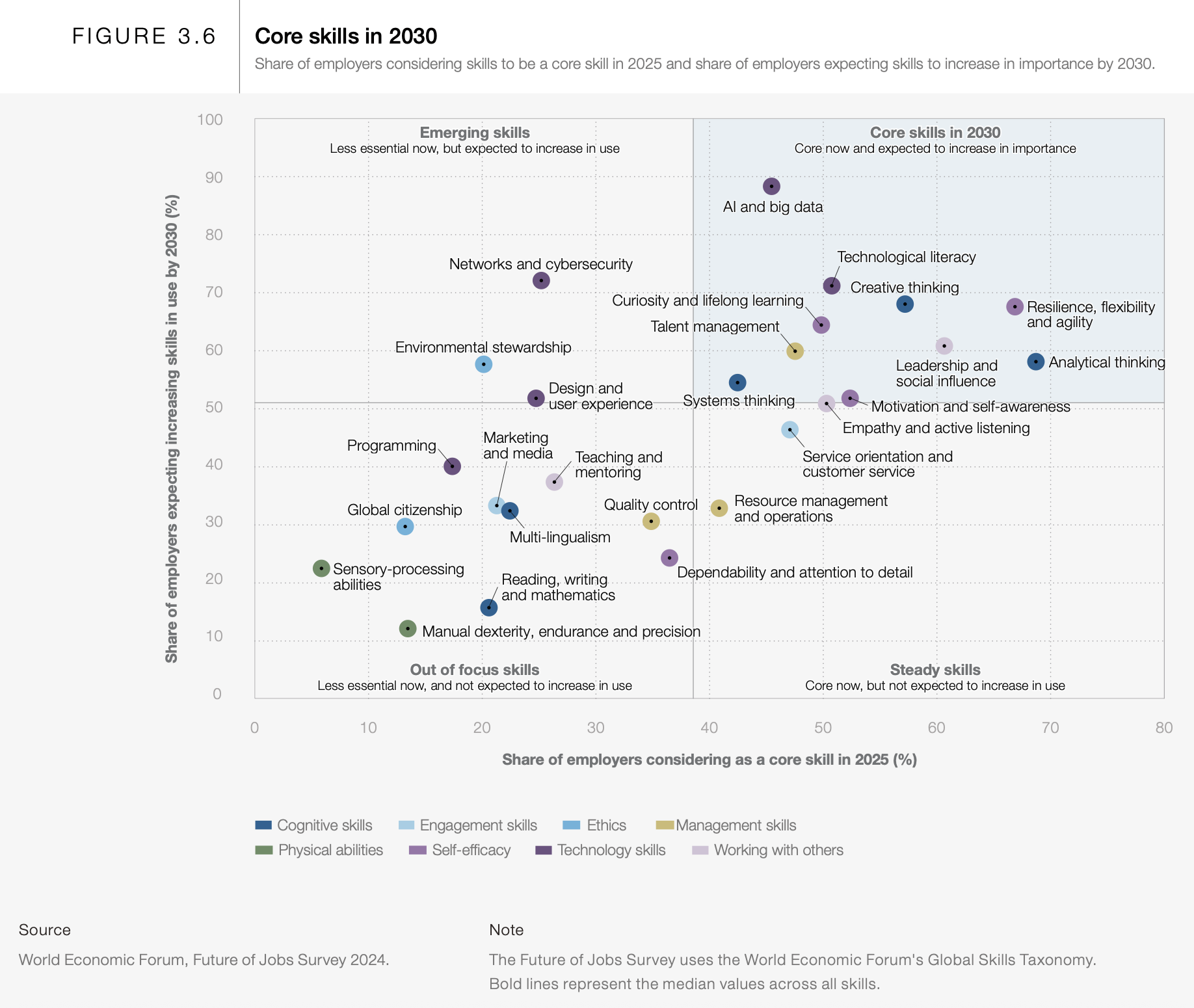
What skills will you need to succeed five years from now? The future of work is rapidly evolving, and the World Economic Forum’s Future of Jobs Report 2025 highlights the crucial skills we need to thrive in 2030. According to the report, analytical thinking is the most sought-after skill, with 7 out of 10 companies considering it essential in 2025. But it doesn’t stop there. Resilience, flexibility, agility, leadership, and social influence are also crucial. What about Artificial Intelligence (AI) and big data? Yup, it’s no surprise that these elements of technological literacy will be in high demand. But among my favorites are creative thinking, curiosity, and lifelong learning, along with motivation and self-awareness. These are skills we can build today!
Let’s explore some of the top skills you’ll need to succeed:
Analytical Thinking: Sharpen your ability to evaluate information, solve complex problems, and make data-driven decisions.
Resilience, Flexibility, and Agility: Embrace change, adapt quickly to new situations, and bounce back from setbacks.
Leadership and Social Influence: Inspire and motivate others, communicate effectively, and build strong relationships.
These aren’t just buzzwords; they’re the keys to unlocking future opportunities. Invest in developing these skills today, and you’ll be well-prepared to navigate the changing landscape of work and achieve your career goals. Where can you go to learn? Try LinkedIn Learning.
People experience different emotions when faced with change. Change can be viewed as a grieving process of sorts. Elisabeth Kubler-Ross described five stages of grief in her seminal work, ‘On Death and Dying’ in 1969.
The five stages include:
Denial
Anger
Bargaining
Depression
Acceptance (+ Moving On)
Kubler-Ross described the experiences of terminally ill patients and the psychological stages they go through when coming to terms with their condition. Her work on grieving process can be adapted to help us understand that individuals go through these same stages when faced with any big change, including changes at work.
Different Faces – Different Paces
Different people move through the stages at different speeds, and there may be some overlap between the stages. It is important for leaders to recognize this individual process. A person’s history, the organization’s history, the type of change and the consequence of change also impact an individual’s response to change and movement through the stages.
How Can Leaders Help Throughout The Stages?
Shock / Denial
Start communicating that there is a change early on. This minimizes the ‘Shock/Denial’ phase, as people will have begun to see that there is a need for change, even if they are unaware of the form that it will take.
When the change initiative is announced, give reasons that reduce complacency and highlight a need for change. Communicate in a way that is clear and touches people emotionally, not just with loads of data. Fully communicate the end vision of the change and what your intentions are.
Don’t try too hard to sell people on the idea that things are better for them; they are not ready to hear this.
Anger
Practice patience and empathy, and don’t try to suppress conflict. Provide a verbal outlet for people to vent their upset feelings. When leaders provide opportunities for grievances and frustrations to be aired constructively, bitterness and frustration can be diminished.
Although people will be angry that doesn’t mean that what they say has no value, they may have legitimate concerns that could affect the success of the change initiative.
Remember that most likely, people are not attacking you personally. Remain calm and patient.
Often leaders have been made aware of a change initiative long before their teams, so although they may be at later stages (eg, be at “Acceptance/Moving on” while general staff are still at “Shock/Denial”). Exercise patience.
Bargaining
When people start trying to bargain, ask them to give the new dispensation a chance. A lot of bargaining is done while people are still angry. Once the anger dissipates, so does much of the bargaining.
Acceptance
Help people acknowledge that it is the end of an era, support them in their new roles and encourage them to take responsibility. Set goals with them of which they can take ownership.
Continue your role as a sounding board for complaints and questions. Ask ‘How do you feel about this?’ to understand individuals’ emotional state.
Begin to stress the benefits of the new situation and how it can work for the individual.
If new teams were formed, provide help with group dynamics. People are generally less concerned with the tasks they are given than how they fit into a new group.
Plan for some early successes for the change initiative and then communicate them loudly. Once people can see that it is working then they will be less skeptical and more positive about the change.
Make sure the necessary resources are available for them to succeed, be it equipment or training or just coaching and guidance.
Moving On
Empower individuals to take the ball and run with it. Let them find ways of using the new set up to create stretch goals and encourage them to push performance.
Let employees innovate and take risks within the new set-up. Let them not only see ways of making the new system work in their favor but put those into practice.
For the individuals who really are taking the ball and running with it, reward them and promote them. Use them to show others what is possible. Having a fellow colleague really driving performance forward using the changes is worth far more than managers telling people things are/will be better. Once people can see it working for a colleague they will be far more receptive to the change.
_______________________________________
Your turn:
What “stage” of change are you leading through right now?







 Susan E. Hendrich