Gemba Kaizen: Unleash the Power of Continuous Improvement

Gemba Kaizen: Unleashing the Power of Continuous Improvement

Let’s explore an extraordinary concept that can revolutionize your approach to leadership by focusing continuous improvement—-but not the “big, sweeping changes” kind of leadership. It’s time to unlock the secrets of Gemba Kaizen, a philosophy that empowers leaders to create positive change right where it matters the most – the gemba, the frontline of their organizations.

What is Gemba Kaizen?

Gemba Kaizen is a Japanese term that translates to “continuous improvement at the actual workplace.” It emphasizes the importance of going to the source, observing processes, and collaborating with employees to drive incremental, sustainable improvements. Gemba Kaizen is not just a methodology; it’s a way of thinking and a catalyst for transformative leadership.

Tip 1: Embrace the Gemba:

To harness the power of Gemba Kaizen, leaders must immerse themselves in the gemba. This means stepping out of their “offices” and into the frontline of their organizations. By personally experiencing the realities of the workplace, leaders gain invaluable insights into the challenges faced by their teams and can actively participate in problem-solving. You may have heard this called, “Management By Walking Around,” or MBWA. There’s an added bonus to this kind of leadership. By being present—literally—with your teams, you see firsthand what they face. And they learn to associate your presence with simply being there, rather than, “Oh no, the boss is here, must be something wrong.”

Tip 2: Empower Your Team:

Gemba Kaizen recognizes that the most valuable improvement ideas come from those closest to the work. To foster a culture of continuous improvement, leaders must empower their teams to voice their ideas, concerns, and suggestions freely. Encourage open communication channels and create a safe space for employees to contribute their expertise and creativity. Make it clear that tiny, incremental changes are welcomed and valued. It is these individual stones, after all, that help to construct—and repair—the great castles.

Tip 3: Foster Collaboration:

Leadership is not a solitary endeavor. Gemba Kaizen thrives on collaboration and cross-functional cooperation. Break down silos, encourage departments to work together, and facilitate dialogue between teams. By fostering collaboration, leaders can leverage diverse perspectives and tap into collective wisdom, leading to innovative solutions and improved outcomes. Send ambassadors in from one team to another, encouraging outside-the-usual thinking.

Tip 4: Practice Active Listening:

To be an effective Gemba Kaizen leader, one must be an active listener. Take the time to engage in meaningful conversations with employees at all levels. Listen attentively to their ideas, concerns, and feedback without judgment. By truly hearing what your team has to say, you will uncover invaluable insights that can fuel positive change.

Tip 5: Lead by Example:

Leadership is not about giving orders from the top; it’s about setting the example. Embody the principles of Gemba Kaizen by actively participating in improvement initiatives, supporting problem-solving efforts, and demonstrating a commitment to continuous learning. By leading from the front, you inspire your team to embrace a culture of continuous improvement.

Tip 6: Encourage Experimentation:

Gemba Kaizen thrives on experimentation. Encourage your team to think outside the box, take calculated risks, and test new ideas. Emphasize that failure is an opportunity for learning and growth rather than a setback. By creating a safe environment for experimentation, you foster innovation and unlock the full potential of your team.

Now it’s time to try Gemba Kaizen:

Gemba Kaizen is a transformative approach to leadership that empowers you to make a tangible impact on your organization’s frontline. By embracing the gemba, empowering your team, fostering collaboration, practicing active listening, leading by example, and encouraging experimentation, you can unlock a world of continuous improvement and unleash the true potential of your organization.

Remember, true leadership is not about grand gestures; it’s about the small, incremental improvements made every day. Embrace Gemba Kaizen, and together, let’s create a culture of continuous improvement that propels us toward a brighter, more prosperous future.

Want to learn more about Gemba Kaizen? Try Gemba Kaizen: A Commonsense Approach to a Continuous Improvement Strategy, by Masaaki Imai.

Future-Proof Your Career: Core Skills You Need for 2030

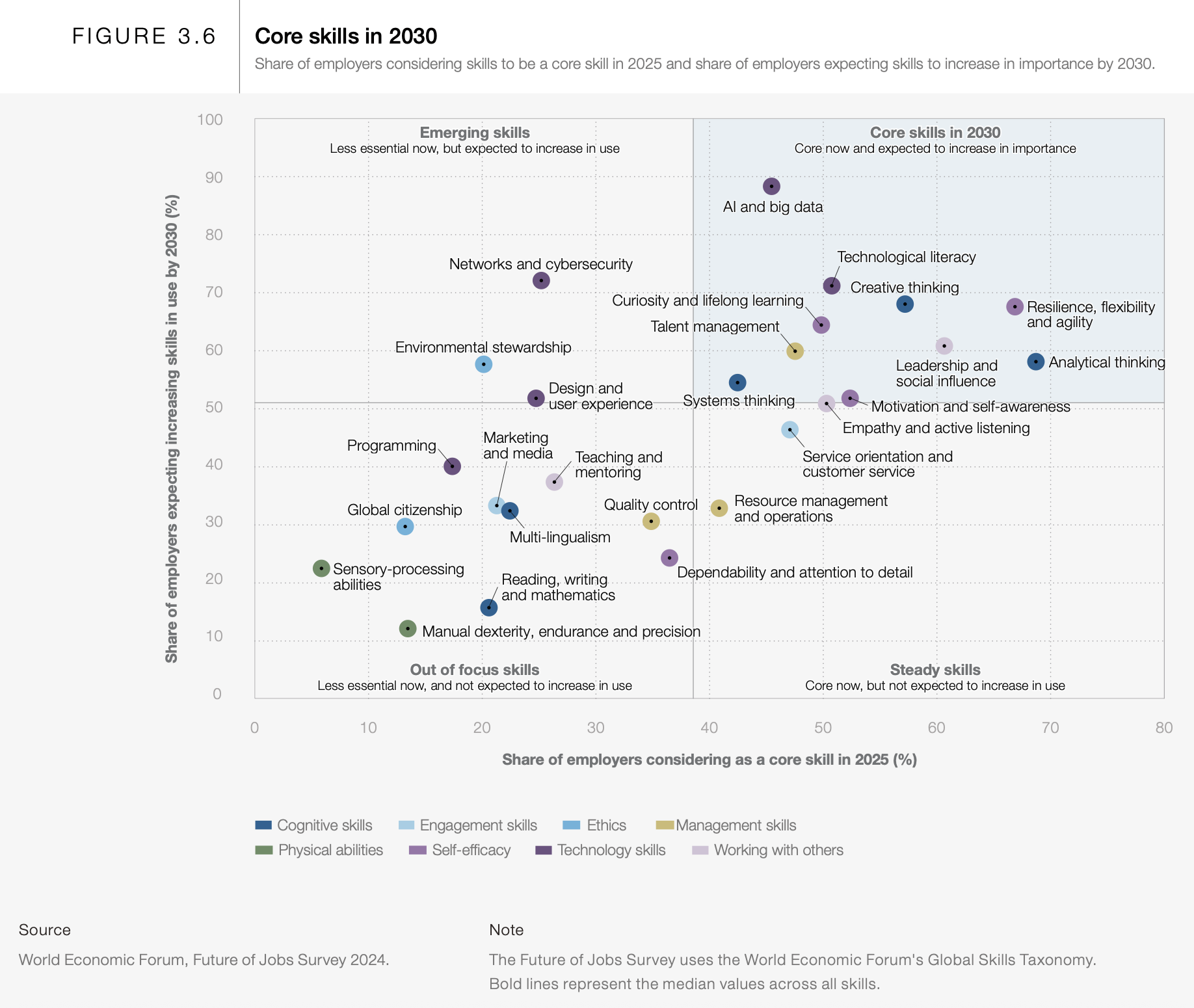
What skills will you need to succeed five years from now? The future of work is rapidly evolving, and the World Economic Forum’s Future of Jobs Report 2025 highlights the crucial skills we need to thrive in 2030. According to the report, analytical thinking is the most sought-after skill, with 7 out of 10 companies considering it essential in 2025. But it doesn’t stop there. Resilience, flexibility, agility, leadership, and social influence are also crucial. What about Artificial Intelligence (AI) and big data? Yup, it’s no surprise that these elements of technological literacy will be in high demand. But among my favorites are creative thinking, curiosity, and lifelong learning, along with motivation and self-awareness. These are skills we can build today!

Let’s explore some of the top skills you’ll need to succeed:

  • Analytical Thinking: Sharpen your ability to evaluate information, solve complex problems, and make data-driven decisions.
  • Resilience, Flexibility, and Agility: Embrace change, adapt quickly to new situations, and bounce back from setbacks.
  • Leadership and Social Influence: Inspire and motivate others, communicate effectively, and build strong relationships.

These aren’t just buzzwords; they’re the keys to unlocking future opportunities. Invest in developing these skills today, and you’ll be well-prepared to navigate the changing landscape of work and achieve your career goals. Where can you go to learn? Try LinkedIn Learning.

#FutureofWork #Skills2030 #CareerDevelopment #WorldEconomicForum

Want to read on? Check out the Future of Jobs Report 2025

Thanks for joining me. Let’s keep the conversation going. Our future depends on it.

Join the Leadership | Learning | Innovation conversation at sashaphilosophy.com.

The Trust Equation: “I don’t care what you know until I know that you care”

Trust: Unlock the Secrets of Human Connection

Trust is fundamental to our connection with others, underpinning every successful relationship, every thriving organization, and every meaningful interaction. Theodore Roosevelt is quoted as coining the phrase, “People don’t care what you know until they know that you care.”

If trust is the bedrock upon which all lasting success is built, how do we build it? How do we maintain it? How do we repair it? I’ve been reflecting on the brilliant work of David Maister, Charles Green, and Robert Galford in their book, “The Trusted Advisor,” and their powerful Trust Equation.

This Trust Equation offers a clear framework for understanding the components of trust.

  • T = Trustworthiness: The outcome we seek.
  • C = Credibility: Do people believe what I say? This isn’t just about technical expertise; it’s about being honest and complete, both intellectually and emotionally. It’s about demonstrating that I understand the facts, but also that I understand the human element.
  • R = Reliability: Do I do what I say I’ll do? It’s the consistent delivery, the repeated experience of promises kept. It’s the bedrock of dependability.
  • I = Intimacy: Can people feel safe sharing their vulnerabilities with me? This isn’t about romantic intimacy, but about emotional closeness and honesty. It’s about creating a space where people feel understood and valued.
  • S = Self-Orientation: This is the denominator, the factor that can erode trust most quickly. Am I focused on myself, or on serving others? Am I listening to understand, or to respond?

What strikes me most about this equation is its simplicity and its profound truth. It highlights that trust is multifaceted. I can be highly credible, but if I’m self-oriented, trust will suffer. I can be reliable, but if I lack intimacy, I’ll never build deep connections. I can be the most transparent (intimate) partner, but if I don’t do what I say I’ll do, trust is shattered.

Why this matters

In a world increasingly driven by transactional interactions, we are at risk of losing sight of the human element. We can forget that people don’t buy what you do; they buy why you do it. And they can only truly connect with your “why” when they trust you.

Think about the leaders you admire. They don’t just possess technical skills; they inspire trust. They are credible, reliable, intimate, and they put the needs of others before their own.

How can I apply this in my own life?

  • Focus on others: I must actively listen, ask open-ended questions, and genuinely care about the people I serve.
  • Be consistent: My actions must align with my words. I need to build a track record of reliability.
  • Be vulnerable: I need to share my own struggles and create a safe space for others to do the same.
  • Check my motives: Am I driven by a desire to serve, or by a desire for personal gain?

David Maister’s Trust Equation is a powerful reminder that building trust is an ongoing process. It requires conscious effort and a genuine commitment to serving others.

May we all strive to build organizations and relationships built on trust, where people feel valued, understood, and inspired. Because when we do, we create a world where everyone can thrive.

Want more? Check out this Trust Equation video from the THNK School of Leadership: https://www.youtube.com/watch?v=xXWDl0Vik48

Change again? Good grief!

How Change is Like Grief

People experience different emotions when faced with change. Change can be viewed as a grieving process of sorts. Elisabeth Kubler-Ross described five stages of grief in her seminal work, ‘On Death and Dying’ in 1969.

The five stages include:

  • Denial
  • Anger
  • Bargaining
  • Depression
  • Acceptance (+ Moving On)

Kubler-Ross described the experiences of terminally ill patients and the psychological stages they go through when coming to terms with their condition. Her work on grieving process can be adapted to help us understand that individuals go through these same stages when faced with any big change, including changes at work.

Different Faces – Different Paces

Different people move through the stages at different speeds, and there may be some overlap between the stages. It is important for leaders to recognize this individual process. A person’s history, the organization’s history, the type of change and the consequence of change also impact an individual’s response to change and movement through the stages.

How Can Leaders Help Throughout The Stages?

Shock / Denial

  • Start communicating that there is a change early on. This minimizes the ‘Shock/Denial’ phase, as people will have begun to see that there is a need for change, even if they are unaware of the form that it will take.
  • When the change initiative is announced, give reasons that reduce complacency and highlight a need for change. Communicate in a way that is clear and touches people emotionally, not just with loads of data. Fully communicate the end vision of the change and what your intentions are.
  • Don’t try too hard to sell people on the idea that things are better for them; they are not ready to hear this.

Anger

  • Practice patience and empathy, and don’t try to suppress conflict. Provide a verbal outlet for people to vent their upset feelings. When leaders provide opportunities for grievances and frustrations to be aired constructively, bitterness and frustration can be diminished.
  • Although people will be angry that doesn’t mean that what they say has no value, they may have legitimate concerns that could affect the success of the change initiative.
  • Remember that  most likely, people are not attacking you personally. Remain calm and patient.
  • Often leaders have been made aware of a change initiative long before their teams, so although they may be at later stages (eg, be at “Acceptance/Moving on” while general staff are still at “Shock/Denial”).  Exercise patience.

Bargaining

When people start trying to bargain, ask them to give the new dispensation a chance. A lot of bargaining is done while people are still angry. Once the anger dissipates, so does much of the bargaining.

Acceptance

  • Help people acknowledge that it is the end of an era, support them in their new roles and encourage them to take responsibility. Set goals with them of which they can take ownership.
  • Continue your role as a sounding board for complaints and questions. Ask ‘How do you feel about this?’ to understand individuals’ emotional state.
  • Begin to stress the benefits of the new situation and how it can work for the individual.
  • If new teams were formed, provide help with group dynamics. People are generally less concerned with the tasks they are given than how they fit into a new group.
  • Plan for some early successes for the change initiative and then communicate them loudly. Once people can see that it is working then they will be less skeptical and more positive about the change.
  • Make sure the necessary resources are available for them to succeed, be it equipment or training or just coaching and guidance.

Moving On

Empower individuals to take the ball and run with it. Let them find ways of using the new set up to create stretch goals and encourage them to push performance.

Let employees innovate and take risks within the new set-up. Let them not only see ways of making the new system work in their favor but put those into practice.

For the individuals who really are taking the ball and running with it, reward them and promote them. Use them to show others what is possible. Having a fellow colleague really driving performance forward using the changes is worth far more than managers telling people things are/will be better. Once people can see it working for a colleague they will be far more receptive to the change.

_______________________________________

Your turn:

What “stage” of change are you leading through right now?

The Audience Arc: A Balancing Act for Success

Master the balancing act of needs using the Audience Arc

In today’s dynamic business landscape, navigating an “audience arc” is crucial for driving high-impact initiatives. This arc applies to any scenario where you need to engage different levels of your organization. Regardless of your situation, there are three core entities to consider as your craft solutions for your customers:

  • The Enterprise: The overarching goals and vision of the organization.
  • The Team: The collective effort and expertise of your department or project group.
  • The Individuals: The unique perspectives and motivations of each person involved.

Now, here’s a powerful framework that can elevate your success:

The Balancing Act: Decisiveness with Context Meets Collaboration for Innovation

Part 1: Decisiveness/Smart Risk-Taking vs. Organizational Navigation/Collaboration

Effective leadership requires a delicate balance. On one hand, you need to be decisive and willing to take calculated risks. However, it’s equally important to navigate the organizational landscape effectively. Collaborative decision-making that considers various viewpoints can lead to stronger results and increased buy-in.

Part 2: Honoring the Past While Embracing the Future

Balancing Tradition with Innovation:

  • Past: Respect What’s Been Done Before: Building on past successes and learning from previous experiences is crucial. Ask yourself, “Has someone already tackled this challenge? Can we leverage their efforts?”
  • Future: Embrace Innovation and Learning: Don’t be afraid to break new ground and experiment. Every situation presents opportunities to learn and push the boundaries.

Conclusion: Mastering the Audience Arc

By understanding the audience arc, consistently creating delicate balance between decisiveness and collaboration, tradition and innovation, you can navigate your way to success in any situation. Winning strategies require considering all three entities – the enterprise, the team, and the individuals. Remember, it’s all about finding the sweet spot between calculated risks and well-coordinated execution. So go forth, analyze, diagnose, plan, and lead your team to high-impact success!