imPERFECT: Better After Broken, with hosts Jeff Servello & Susan Hendrich.
Welcome to the premiere episode of the new radio podcast, imPERFECT: Better After Broken. Join us Sundays at 6 pm ET on Sandcastle Radio, America’s Hottest Online Variety & Music Station.
Hosts Jeff Servello and Dr. Susan Hendrich share raw stories of repair, resilience, and what it takes to rebuild stronger. This is a conversation about breaking, healing, and coming back with more clarity, more courage, and more purpose.
Sometimes the break is the breakthrough. And, your best may still be ahead.
Hope is an active, learned conviction in one’s ability to influence outcomes, sharing personal experiences and insights.
Hope is essential in leadership and impacts team performance. Hope is not just a personality trait, but a skill that can be developed through practice. There is scientific basis to hope. Neuroplasticity can be harnessed through various practices to cultivate resilience and courage in the face of adversity.
Cultivating Hope
Albert Bandura said that hope is an active, learned conviction in one’s ability to influence outcomes rather than passive wishing. Hopeful people don’t give up when faced with obstacles, but instead seek alternative routes.
Stirring Up Hope Through Leadership
Having hope, setting goals, and maintaining self-belief lead to success. Hope is an active verb, not a passive feeling. You can develop hope through learned habits and multiply it with leadership.
Hope as a Strategic Tool
Hope is a tool for leaders and individuals facing complexity. It’s not optimism or positive thinking, but the belief in one’s ability to shape a future and the creativity to find pathways to achieve goals. When hope is lost, people stop taking purposeful action and become less adaptable. You can learn to recognize and nurture hope as a fundamental force for navigating uncertainty.
Join us at 10 a.m. Eastern on sandcastleradio.org to explore how to stir up hope in your own life.
Listen to Human Being with Dr. Susan every Saturday at 10 am ET on Sandcastle Radio, America’s Hottest Online Variety and Music Station. Follow Susan at / @susanhendrich
Explore the Human Being with Dr. Susan podcast: 13 episodes
Agility and the Unlit Candle: A Personal Story from My Mom
Here’s a personal story about agility—a story from my mom. It’s a story that lives at the center of my family history—my personal history. Years ago, she wrote it down and titled it “The Unlit Candle.” It’s a story about disruption, resilience, and the unexpected moments when life forces you to pivot into a different version of yourself.
1970: A New Start in Delaware The year was 1970. My parents were brand new to Delaware—young, hopeful, starting out with a baby girl and a handful of dreams. My mom had left her job at the University of Illinois to care for me. My dad had just started his first role as a chemist at DuPont. That’s why they moved to Wilmington. Money was tight. Life was simple, but it was good. My mom planned my first birthday with absolute joy. She baked a beautiful cake, decorated it with balloons and baby toys, and placed one large candle in the center—unlit, waiting for the moment. Family came in by train. They rented chairs for the living room. It felt like the beginning of something.
The Fire But the morning of the celebration, just before lunch, my dad said, “Hold up. I smell smoke.” He opened the apartment door, and a wall of thick black smoke poured in. In seconds, my mom grabbed me. Everyone ran out barefoot into the sunlit parking lot, watching as the fire department fought flames pouring out of the lower level. That beautiful cake never got sliced. That candle never got lit. Later that day, once the fire was out, they were allowed back in to salvage what they could. Much was destroyed—clothes, keepsakes, their few newlywed belongings. Even the wire hangers were covered in soot and had to be scrubbed by hand. My parents had no renters’ insurance, no safety net—just each other and a baby with a birthday that never happened.
Aftermath and Unexpected Generosity My parents relocated us to a motel. My grandmother and my aunt went back home. My mother called her family, embarrassed and overwhelmed. My Aunt Judy got on a plane immediately, traveling from Illinois to help. A local professor’s parents opened their ornate home to my parents and the baby—people they’d never met, because generosity has a way of finding people who need it. Eventually, my parents moved into a small bungalow and then into the home they still live in today. One disruption after another, and yet somehow they kept finding the next right move.
The Lesson My Mom Never Wrote That’s the part my mom never wrote explicitly—but what the story teaches: agility is born in moments you never asked for. The moments where the plan burns down, literally or figuratively, and you’re left standing in the parking lot with nothing but a baby on your hip and a cake you never got to eat.
The Meaning of the Unlit Candle The unlit candle became more than a story. It became a truth—a celebration that didn’t happen, plans that got erased, a version of life that didn’t survive the smoke. But also this truth: some candles don’t need to be lit to change your life. That day taught my mother—and eventually me—that agility isn’t a personal trait. It’s a response pattern. A willingness to regroup when you’re exhausted, to pivot when you’re heartbroken, to rebuild when you’ve already rebuilt more times than feels fair. It’s the ability to say, “Okay, this isn’t the story we planned, but it’s the story we’re in, and we’ll write the next chapter from here.”
Glimpses of a New Beginning The unlit candle reminds me that every disruption contains a glimpse of a new beginning—even if you don’t see it at first, even if it’s wrapped in smoke, even if it costs you more than you thought you could bear. My mom survived that season. My parents built a life from those ashes. They restored what they could. They released what they couldn’t. And they kept moving forward.
What Agility Really Looks Like That is agility. Not glamorous. Not poetic. Not Instagram-worthy. Just steady, human, persistent movement through uncertainty. And sometimes the most powerful symbol isn’t the candle you light—it’s the candle you never got to. I’m proud of my parents. And I think part of my agility comes from that moment when we lost everything in the fire.
___________________________
Wishing you glimpses of new beginnings, even when your candle remains unlit.
Susan Hendrich, with special thanks to my amazing Mom, Virginia Hertzenberg
Imposter Syndrome is the persistent inability to believe that your success is deserved or has been legitimately achieved as a result of your own efforts or skills. It’s a feeling of being a fraud, and it’s more common than you think.
🎭
Feeling Like a Fraud
Despite your accomplishments, you have a nagging fear that you’ll be “found out” as a fake.
🍀
Attributing Success to Luck
You dismiss your achievements as luck, timing, or other external factors, not your own ability.
📉
Minimizing Achievements
You downplay your successes, believing anyone could have done what you did.
🎯
Perfectionism Pressure
You believe you must be perfect, and any small mistake proves your incompetence.
The Imposter’s Mindset: A Skewed Perspective
Imposter syndrome often involves a distorted “locus of control”—how we explain the cause of events. We have one rule for others, and a different, harsher rule for ourselves.
When OTHERS Succeed
We attribute it to their internal qualities:
“They’re naturally talented.”
“They are so intelligent and capable.”
“Their hard work really paid off.”
When *I* Succeed
I attribute it to external factors:
“I just got lucky this time.”
“They must have lowered the standards.”
“Someone helped me, I couldn’t do it alone.”
Recognizing this pattern is the first step toward changing it and owning your success.
You’re in Good Company
Feeling like an imposter doesn’t mean you are one. Countless icons of science, art, and leadership have felt the exact same way.
“The exaggerated esteem in which my lifework is held makes me very ill at ease. I feel compelled to think of myself as an involuntary swindler.”
– Albert Einstein
“I have written eleven books, but each time I think, ‘Uh oh, they’re going to find out now. I’ve run a game on everybody, and they’re going to find me out.'”
– Maya Angelou
“No matter what we’ve done, there comes a point where you think, ‘How did I get here? When are they going to discover that I am, in fact, a fraud…?'”
– Tom Hanks
“It’s almost like the better I do, the more my feeling of inadequacy actually increases… ‘Any moment, someone’s going to find out I’m a total fraud.'”
– Emma Watson
“I still have a little impostor syndrome… It doesn’t go away, that feeling that you shouldn’t take me that seriously. What do I know?”
– Michelle Obama
“I am always looking over my shoulder wondering if I measure up.”
– Sonia Sotomayor
Interactive Toolkit: Rewire Your Thinking
Actively challenging the imposter voice is key. Use these simple exercises to start building a more accurate, self-compassionate inner narrative.
Activity: “Who, Me?” “Yeah, Me!”
Challenge the voice of doubt with facts. Think of a recent success and reframe it.
My Recent Achievement:
My “Yeah, Me!” Response:
Activity: My Strengths, My Truths
Remind yourself of your inherent, undeniable qualities.
My Truth #1:
My Truth #2:
My Truth #3:
Your Toolkit for Brilliance
Integrate these concepts and strategies into your daily life to build lasting confidence and keep imposter syndrome at bay.
Talk About It
Sharing your feelings with trusted friends or mentors can lift a huge weight and show you you’re not alone.
Focus on Facts
Keep an “Accomplishment Journal.” When doubt creeps in, review the concrete evidence of your competence.
Embrace “Good Enough”
Striving for perfection is a trap. Aim for progress, not flawlessness. Mistakes are for learning, not for shame.
Artist vs. Critic
Separate the creative “Artist” from the judgmental “Critic” in your mind. Let the Artist work freely before the Critic gets a say.
Power Poses
Before a challenge, stand tall for 2 minutes. Adopt a confident posture to influence your mindset. Your body can lead your mind.
Own Your Vulnerability
As Brené Brown says, true courage is showing up and being seen when you can’t control the outcome. It’s strength, not weakness.
How Common Is It?
While exact numbers vary, studies suggest a vast majority of people—up to 82% in some research—experience these feelings at some point. It shows that feeling like an imposter is a shared human experience, not a personal defect.
Why do we do certain things in a particular way? We all have routines, traditions, and practices that we follow without much conscious thought. Often, these habits are deeply ingrained, passed down through generations, or simply adopted because, well, that’s just how it’s always been done.
I had an enlightening conversation with a colleague today about recurrent obstacles. Our team was trying to solve a small but frustrating problem that has persisted for more than a year. As a new member of the team, eager to help, I started thinking about ways to solve the problem. All of my ideas centered on how we can do more. (You know, because that’s how we always solve this problem, by doing more.) My colleague asked me a challenging question that changed my perspective altogether: “What if the problem IS the problem?” In other words, why are we trying to solve this problem in the first place? What if the answer is to do less?
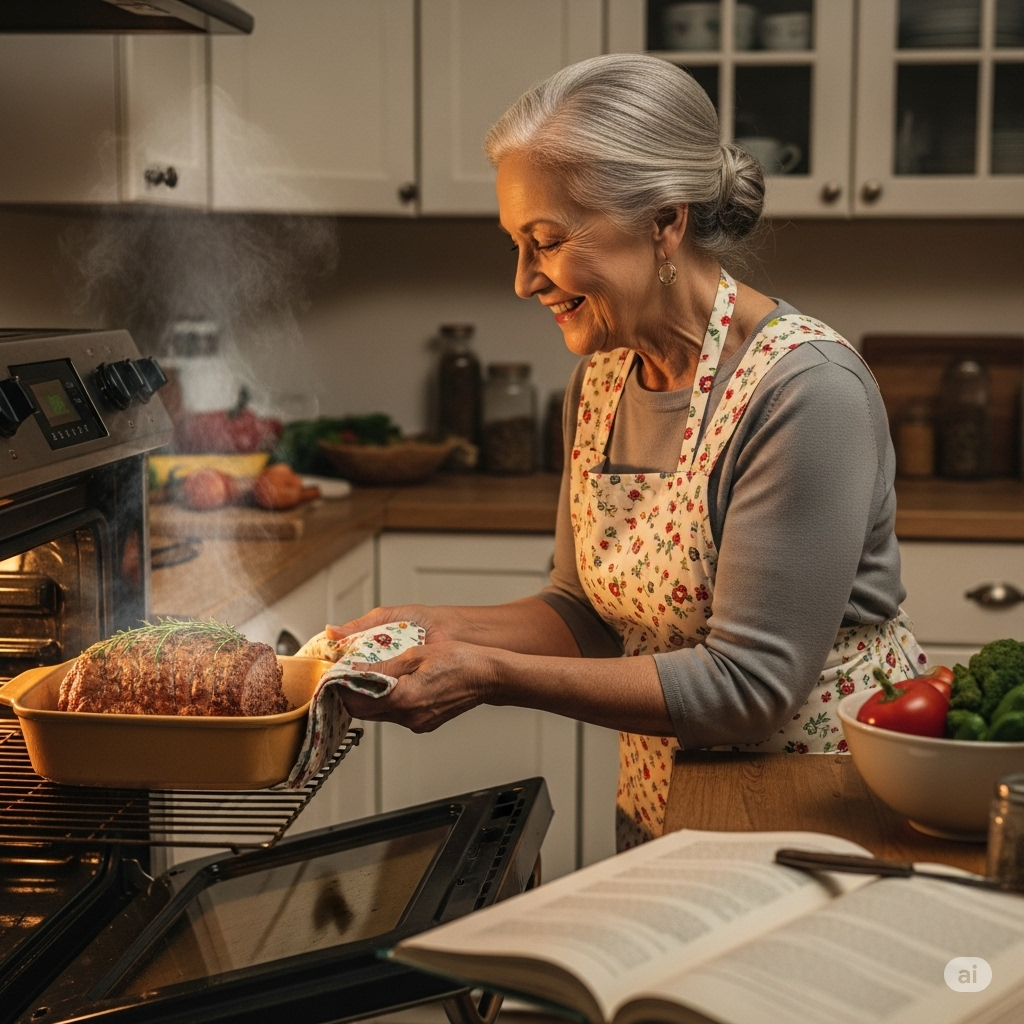
This brings to mind a classic tale, often shared in leadership and organizational development circles: The Pot Roast Story. The story goes something like this:
THE POT ROAST STORY
A young woman is preparing a pot roast, and before placing it in the oven, she carefully cuts off both ends of the roast. Her husband, observing this, asks her why she does it. She thinks for a moment and replies, “That’s how my mother always did it.” Intrigued, the husband then asks her mother, who gives the same answer: “That’s how my mother always did it.”
Finally, they decide to ask the grandmother, the original source of the culinary tradition. With a twinkle in her eye, the grandmother explains, “Because my roasting pan was too small!”
A Simple Story with Profound Implications
The pot roast story, while seemingly trivial, offers a powerful metaphor for many aspects of our lives, both personal and professional:
Unquestioned Assumptions: How many of our processes, procedures, or even beliefs are based on assumptions that are no longer valid, or perhaps never were? We often operate on “that’s how we’ve always done it” without ever asking “why?”
The Power of Tradition: Traditions can be wonderful, offering comfort, connection, and a sense of history. However, when traditions become rigid and unquestioned, they can stifle innovation and prevent us from finding more efficient or effective ways of doing things.
The Importance of Curiosity: The husband’s simple question, “Why?”, is the catalyst for uncovering the truth. Curiosity is a vital trait, encouraging us to explore, challenge the status quo, and seek deeper understanding.
Adapting to Change: The grandmother’s reason highlights the need to adapt. Her original method was a practical solution to a specific problem (a small pan). Over time, circumstances change, and our methods should evolve accordingly. Are we still cutting off the ends of our “pot roasts” when our “pans” are now much larger?
Leadership and Critical Thinking: In a leadership context, this story is a potent reminder to encourage critical thinking within teams. Are we fostering an environment where people feel comfortable asking “why?” Are we regularly reviewing our processes to ensure they are still relevant and efficient?
Breaking Free from the “Pot Roast” Mentality
So, how can we avoid falling into the “pot roast” trap?
Ask “Why?”: Before blindly following a process, take a moment to understand its origin and purpose. Is it still serving its original function?
Challenge the Status Quo: Don’t be afraid to question established norms. Just because something has always been done a certain way doesn’t mean it’s the best way.
Encourage Inquiry: Foster a culture where curiosity is valued, and asking questions is encouraged, not seen as a challenge.
Embrace Adaptability: Be willing to let go of old methods when new, better solutions emerge.
Seek the “Grandmother’s” Wisdom: Sometimes, the most valuable insights come from those who have been around the longest and understand the historical context. But even then, apply critical thinking to their insights!
The pot roast story is more than just a charming anecdote; it’s a powerful lesson in critical thinking, adaptability, and the importance of questioning the unquestioned. By taking the time to understand the “why” behind our actions, we can unlock greater efficiency, foster innovation, and ensure we’re not just cutting off the ends of our pot roast for no good reason.
What “pot roast” traditions are you ready to examine in your own life or work? Share your thoughts in the comments below.

 Susan E. Hendrich