7 Coaching Questions to Unlock Excellence

Seven powerful coaching questions to unlock excellence. Let’s discuss. This isn’t just about managing people; it’s about a skill crucial for leadership and personal growth. It’s a skill you and I both need.

In a discussion today with a colleague, I revisited a book that profoundly shifted my perspective on leadership and development: The Coaching Habit” by Michael Bungay Stanier. It’s not just a good read; it’s a foundational text that unveils the simplicity and profound impact of effective questioning. Michael lays out a framework of seven deceptively simple yet powerful questions. What struck me, and what I believe is a core truth for all leaders, is this: Everyone is a coach.

Whether you lead a large organization, mentor a small team, or simply aim to guide a friend through a tough spot, the essence of coaching is invaluable. It’s about empowering others to find their own solutions, fostering autonomy and resilience. So, let’s dive into Michael’s framework, a practical guide for unlocking potential in yourself and those around you.


The Seven Essential Coaching Questions

1. “What’s on your mind?”

This is your Kickstart Question. It’s designed to bypass superficial pleasantries and dive straight into what truly occupies someone’s attention. It’s an invitation to share what’s exciting them, causing anxiety, or consuming their focus. As leaders, moving beyond small talk directly signals that you value their time and their most pressing concerns.

2. “And what else?”

Don’t underestimate the power of this Awe Question. Its simplicity belies its critical role. It serves two vital purposes:

  • It pushes past the initial, often superficial, response to uncover what’s genuinely at stake.
  • It prevents us from jumping prematurely into problem-solving mode, keeping the conversation in a crucial discovery phase.

The first thought shared is rarely the most significant. This question acts as a continuous probe, digging deeper to reveal the true underlying issues.

3. “What’s the real challenge here for you?”

This is the Focus Question, and it’s transformative. The emphasis on “real challenge” ensures we address the core issue, not just a symptom. The addition of “for you” brings the focus directly back to the individual. As a leader, you can only coach the person in front of you. This question helps them internalize the problem, preventing them from externalizing blame and encouraging personal accountability.

4. “What do you want?”

The Foundation Question clarifies the desired outcome. Asking “what do you want?” is an act of empowerment, creating psychological safety and granting autonomy. It also marks a critical pivot from reflection to action. Effective coaching facilitates progress, and clear desired outcomes are the first step toward achieving them.

5. “How can I help?”

I refer to this as the Lazy Question, but it’s anything but passive. It’s a strategic move for two key reasons:

  • It places ownership on the other person for the next steps, fostering self-reliance.
  • It prevents you from assuming you know the best course of action.

Just as “and what else?” curbs premature advice, “how can I help?” stops us from jumping into action before the true request is clear. Once a request is made, your response options are clear: “Yes,” “No,” “Perhaps, but differently,” or “Let me consider that.” The goal is clarity, not automatic obligation.

6. “If you’re saying yes to this, what are you saying no to?”

This is the Strategic Question, crucial for fostering focus and prioritization. Resources—time, attention, energy—are finite. Every “yes” inherently requires a “no.” This question forces a commitment, not just to what they will do, but to what they will not.

Consider both the “no of omission” (options automatically excluded by a choice) and the “no of commission” (what must be actively set aside—be it projects, habits, or old beliefs—to fully commit to the “yes”). A true “yes” demands the clarity of boundaries.

7. “What was most useful for you?”

Finally, the Learning Question. Genuine learning doesn’t happen just by doing or telling; it’s solidified through recall and reflection. Asking this question at the close of a coaching conversation creates a vital learning moment, reinforcing key insights and embedding “aha” moments. Leaders must create space for this reflection to ensure that learning sticks and translates into lasting change.


Embracing the Coaching Mindset

This framework offers a powerful sequence, though its application isn’t rigid. You might not use all questions, or perhaps not in this exact order. The underlying principle, however, is constant: the best way to help someone develop is by asking questions and empowering them to discover their own answers. This counter-intuitive approach—resisting the urge to advise—is the hallmark of truly impactful leadership.

Put these questions into practice this week. Observe the shifts, both in others and in yourself.


What profound questions have shaped your approach to leadership and coaching? I’d love to hear your insights.

Join the Leadership | Learning | Innovation conversation at sashaphilosophy.com.

Future-Proof Your Career: Core Skills You Need for 2030

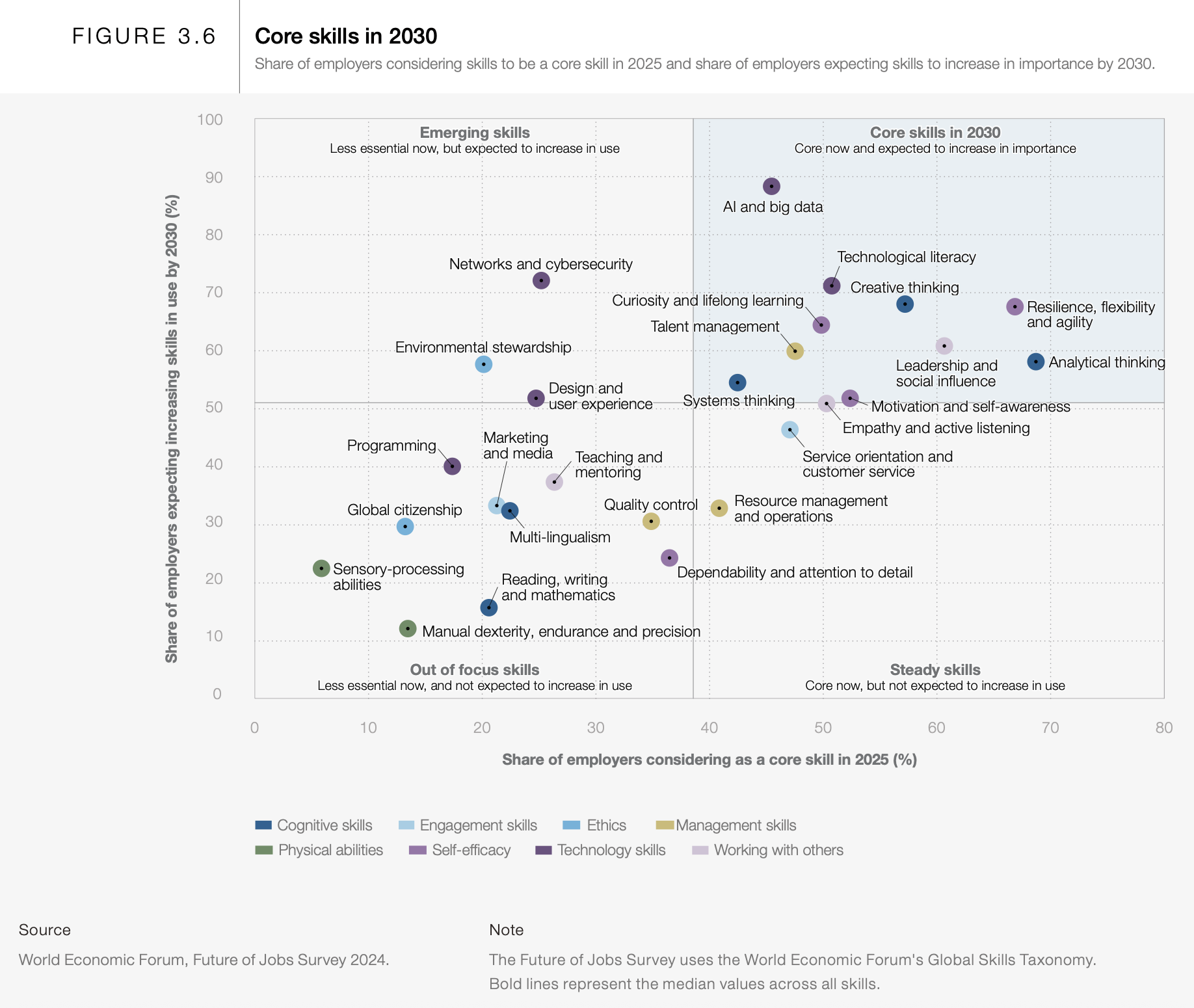
What skills will you need to succeed five years from now? The future of work is rapidly evolving, and the World Economic Forum’s Future of Jobs Report 2025 highlights the crucial skills we need to thrive in 2030. According to the report, analytical thinking is the most sought-after skill, with 7 out of 10 companies considering it essential in 2025. But it doesn’t stop there. Resilience, flexibility, agility, leadership, and social influence are also crucial. What about Artificial Intelligence (AI) and big data? Yup, it’s no surprise that these elements of technological literacy will be in high demand. But among my favorites are creative thinking, curiosity, and lifelong learning, along with motivation and self-awareness. These are skills we can build today!

Let’s explore some of the top skills you’ll need to succeed:

  • Analytical Thinking: Sharpen your ability to evaluate information, solve complex problems, and make data-driven decisions.
  • Resilience, Flexibility, and Agility: Embrace change, adapt quickly to new situations, and bounce back from setbacks.
  • Leadership and Social Influence: Inspire and motivate others, communicate effectively, and build strong relationships.

These aren’t just buzzwords; they’re the keys to unlocking future opportunities. Invest in developing these skills today, and you’ll be well-prepared to navigate the changing landscape of work and achieve your career goals. Where can you go to learn? Try LinkedIn Learning.

#FutureofWork #Skills2030 #CareerDevelopment #WorldEconomicForum

Want to read on? Check out the Future of Jobs Report 2025

Thanks for joining me. Let’s keep the conversation going. Our future depends on it.

Join the Leadership | Learning | Innovation conversation at sashaphilosophy.com.

The Trust Equation: “I don’t care what you know until I know that you care”

Trust: Unlock the Secrets of Human Connection

Trust is fundamental to our connection with others, underpinning every successful relationship, every thriving organization, and every meaningful interaction. Theodore Roosevelt is quoted as coining the phrase, “People don’t care what you know until they know that you care.”

If trust is the bedrock upon which all lasting success is built, how do we build it? How do we maintain it? How do we repair it? I’ve been reflecting on the brilliant work of David Maister, Charles Green, and Robert Galford in their book, “The Trusted Advisor,” and their powerful Trust Equation.

This Trust Equation offers a clear framework for understanding the components of trust.

  • T = Trustworthiness: The outcome we seek.
  • C = Credibility: Do people believe what I say? This isn’t just about technical expertise; it’s about being honest and complete, both intellectually and emotionally. It’s about demonstrating that I understand the facts, but also that I understand the human element.
  • R = Reliability: Do I do what I say I’ll do? It’s the consistent delivery, the repeated experience of promises kept. It’s the bedrock of dependability.
  • I = Intimacy: Can people feel safe sharing their vulnerabilities with me? This isn’t about romantic intimacy, but about emotional closeness and honesty. It’s about creating a space where people feel understood and valued.
  • S = Self-Orientation: This is the denominator, the factor that can erode trust most quickly. Am I focused on myself, or on serving others? Am I listening to understand, or to respond?

What strikes me most about this equation is its simplicity and its profound truth. It highlights that trust is multifaceted. I can be highly credible, but if I’m self-oriented, trust will suffer. I can be reliable, but if I lack intimacy, I’ll never build deep connections. I can be the most transparent (intimate) partner, but if I don’t do what I say I’ll do, trust is shattered.

Why this matters

In a world increasingly driven by transactional interactions, we are at risk of losing sight of the human element. We can forget that people don’t buy what you do; they buy why you do it. And they can only truly connect with your “why” when they trust you.

Think about the leaders you admire. They don’t just possess technical skills; they inspire trust. They are credible, reliable, intimate, and they put the needs of others before their own.

How can I apply this in my own life?

  • Focus on others: I must actively listen, ask open-ended questions, and genuinely care about the people I serve.
  • Be consistent: My actions must align with my words. I need to build a track record of reliability.
  • Be vulnerable: I need to share my own struggles and create a safe space for others to do the same.
  • Check my motives: Am I driven by a desire to serve, or by a desire for personal gain?

David Maister’s Trust Equation is a powerful reminder that building trust is an ongoing process. It requires conscious effort and a genuine commitment to serving others.

May we all strive to build organizations and relationships built on trust, where people feel valued, understood, and inspired. Because when we do, we create a world where everyone can thrive.

Want more? Check out this Trust Equation video from the THNK School of Leadership: https://www.youtube.com/watch?v=xXWDl0Vik48

Change again? Good grief!

How Change is Like Grief

People experience different emotions when faced with change. Change can be viewed as a grieving process of sorts. Elisabeth Kubler-Ross described five stages of grief in her seminal work, ‘On Death and Dying’ in 1969.

The five stages include:

  • Denial
  • Anger
  • Bargaining
  • Depression
  • Acceptance (+ Moving On)

Kubler-Ross described the experiences of terminally ill patients and the psychological stages they go through when coming to terms with their condition. Her work on grieving process can be adapted to help us understand that individuals go through these same stages when faced with any big change, including changes at work.

Different Faces – Different Paces

Different people move through the stages at different speeds, and there may be some overlap between the stages. It is important for leaders to recognize this individual process. A person’s history, the organization’s history, the type of change and the consequence of change also impact an individual’s response to change and movement through the stages.

How Can Leaders Help Throughout The Stages?

Shock / Denial

  • Start communicating that there is a change early on. This minimizes the ‘Shock/Denial’ phase, as people will have begun to see that there is a need for change, even if they are unaware of the form that it will take.
  • When the change initiative is announced, give reasons that reduce complacency and highlight a need for change. Communicate in a way that is clear and touches people emotionally, not just with loads of data. Fully communicate the end vision of the change and what your intentions are.
  • Don’t try too hard to sell people on the idea that things are better for them; they are not ready to hear this.

Anger

  • Practice patience and empathy, and don’t try to suppress conflict. Provide a verbal outlet for people to vent their upset feelings. When leaders provide opportunities for grievances and frustrations to be aired constructively, bitterness and frustration can be diminished.
  • Although people will be angry that doesn’t mean that what they say has no value, they may have legitimate concerns that could affect the success of the change initiative.
  • Remember that  most likely, people are not attacking you personally. Remain calm and patient.
  • Often leaders have been made aware of a change initiative long before their teams, so although they may be at later stages (eg, be at “Acceptance/Moving on” while general staff are still at “Shock/Denial”).  Exercise patience.

Bargaining

When people start trying to bargain, ask them to give the new dispensation a chance. A lot of bargaining is done while people are still angry. Once the anger dissipates, so does much of the bargaining.

Acceptance

  • Help people acknowledge that it is the end of an era, support them in their new roles and encourage them to take responsibility. Set goals with them of which they can take ownership.
  • Continue your role as a sounding board for complaints and questions. Ask ‘How do you feel about this?’ to understand individuals’ emotional state.
  • Begin to stress the benefits of the new situation and how it can work for the individual.
  • If new teams were formed, provide help with group dynamics. People are generally less concerned with the tasks they are given than how they fit into a new group.
  • Plan for some early successes for the change initiative and then communicate them loudly. Once people can see that it is working then they will be less skeptical and more positive about the change.
  • Make sure the necessary resources are available for them to succeed, be it equipment or training or just coaching and guidance.

Moving On

Empower individuals to take the ball and run with it. Let them find ways of using the new set up to create stretch goals and encourage them to push performance.

Let employees innovate and take risks within the new set-up. Let them not only see ways of making the new system work in their favor but put those into practice.

For the individuals who really are taking the ball and running with it, reward them and promote them. Use them to show others what is possible. Having a fellow colleague really driving performance forward using the changes is worth far more than managers telling people things are/will be better. Once people can see it working for a colleague they will be far more receptive to the change.

_______________________________________

Your turn:

What “stage” of change are you leading through right now?

Stepping Away to Step Up: Why Renewal is Your Secret Weapon

Recharge and Refresh to Enhance Your Impact.

Life can be a whirlwind sometimes. Work deadlines loom, errands pile up, and suddenly it feels like you haven’t taken a real breath in days, weeks, even months. It’s during these times that I find myself craving renewal. Take a deep breath while you think about that word…renewal.

Now, renewal might not sound like the most exciting thing on the to-do list, but hear me out. It’s not about sitting in a bubble bath for thirty minutes (although that has its merits). It’s about consciously choosing to step away from the hamster wheel, even if it’s just for a little while, to come back feeling refreshed and ready to tackle anything.

Think about it. Have you ever tried to write a creative piece when your brain feels like mush? Or tried to have a productive conversation when you’re running on fumes? It rarely ends well. We need time to recharge, refocus, and reconnect with ourselves in order to truly thrive.

Here’s the thing, renewal doesn’t have to be a grand gesture. It can be as simple as:

  • Taking a walk in nature: Immersing yourself in the sights and sounds of the outdoors can be incredibly calming and restorative.
  • Putting your phone down and reading a book: Escaping into a good story can help you de-stress and gain new perspectives.
  • Trying a new recipe: Engaging in a creative activity can spark joy and get your creative juices flowing again.
  • Spending time with loved ones: Connecting with those closest to you provides a sense of belonging and support.

Even small changes to your routine can have a big impact. Instead of scrolling through social media before bed, try some light stretching or reading. Replace your usual commute with a scenic bike ride.

The key is to find what works for you and make it a priority. Remember, renewal isn’t selfish, it’s essential. It’s the key to maintaining your energy, creativity, and overall well-being. So next time you’re feeling burnt out, don’t push yourself further. Step away, recharge, and come back stronger than ever.

I’m heading outside now to breathe in the crisp February air and renew my focus for the week ahead. How will you RENEW?

Susan

p.s. Looking for a book to guide your journey? Check out: Renewal: How Nature Awakens Our Creativity, Compassion, and Joy by Andrés R Edwards