Courage and Resilience

Courage and Resilience: Inspiration from a Holocaust survivor

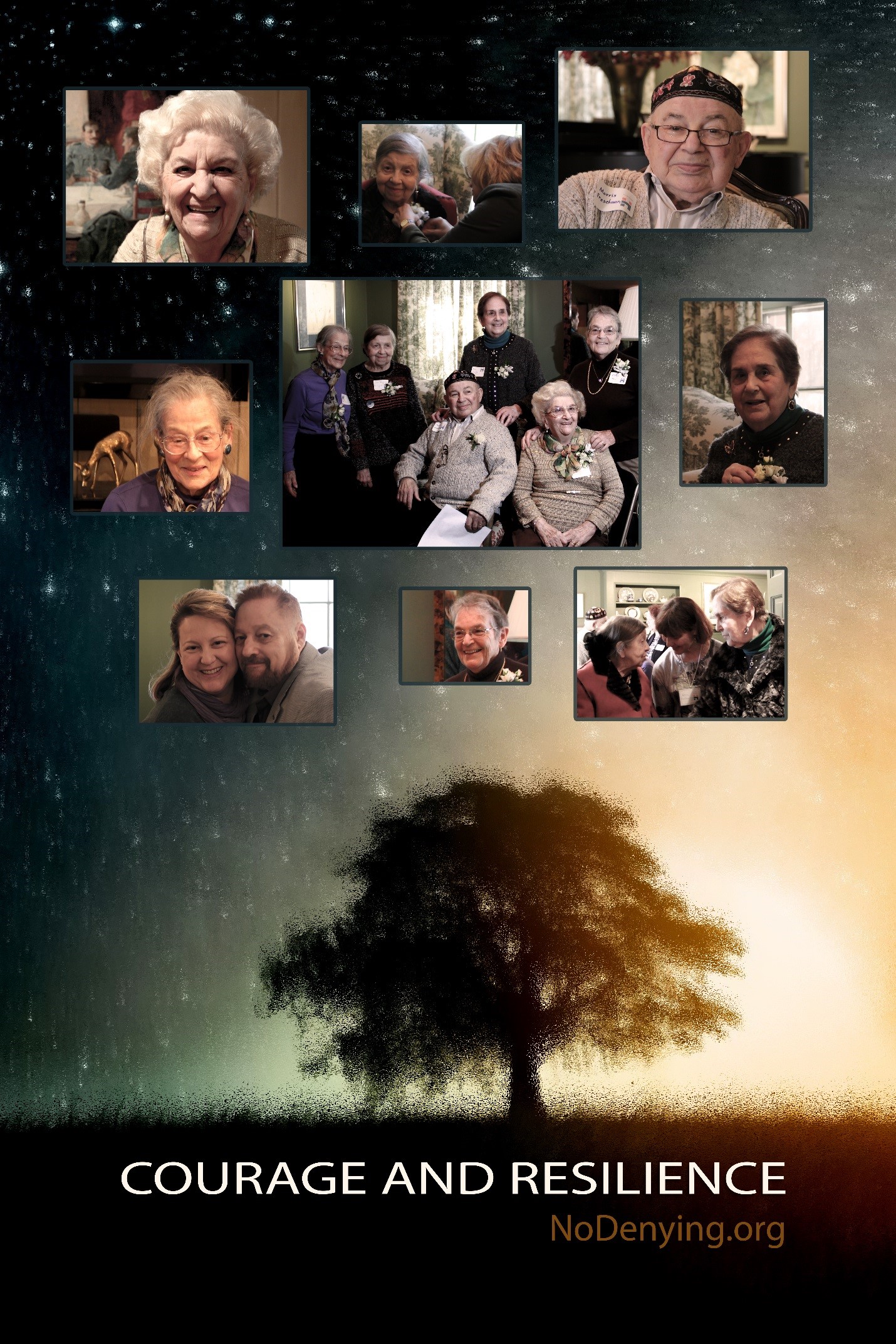
Holocaust survivor Morris Freschman allowed me a freedom I have never before experienced, and he inspired me to design Courage and Resilience, a project that began as a poster commemorating Morris and all Holocaust survivors, liberators, and righteous gentiles.

“You cannot keep a grudge; you cannot have hate because it destroys people. You have to forgive people or it will destroy you.” – Morris Freschman, Holocaust Survivor

CourageAndResilience_web.jpg

Meet Morris

Anyone who’s shopped the New Castle Farmers Market in Delaware may recall Freschies Deli, where Morris Freschman sold delicious fresh food for many years. He warmly greeted his customers with a twinkle in his eye and an infectious smile. Behind those sparkling eyes, Morris carries the memories of losing most of his family to murder, and suffering four horrific years of his youth in the concentration camps of Blechhammer (a satellite camp of Auschwitz), Gross-Rosen, and Buchenwald. Underneath the sleeve of his crisply ironed shirt, the number 177060 is emblazoned on his arm, tattooing more than just his survival, but his courage and resilience in the face of unimaginable suffering.

Morris was born in Sarnov, Poland on May 3, 1929 to David and Ida Freschman. David and Ida, along with all but one of Morris’ eight siblings, would perish along with millions in the Holocaust. Somehow, through a series of miracles, Morris survived. But it wasn’t until 2004 that Morris was able to speak publicly about his Holocaust experience, when he was interviewed by documentary producer Steve Gonser. In April 2016, I had the honor of meeting Morris and five other Holocaust survivors at the home of my parents’ friends, Roger and Danna Levy, where more than 60 people gathered to hear the stories of survivors, liberators and righteous gentiles through an excerpted screening of  the documentary No Denying: Delawareans Bear Witness to the Holocaust,” by filmmaker by Steve Gonzer on behalf of the Halina Wind Preston Holocaust Education Center.

Once the film snippets concluded, and with hesitation and heavy sighs, Morris stood among the crowd and spoke of his own times of courage and resistance. He shared five miracles that kept him alive during the Holocaust:

  • Miracle 1: The first miracle happened when Morris was ten years old and was forced along with his family to live in the Polish ghetto. Morris was working to smuggle food to his cousin’s store, and was hiding two packages of eggs in his shirt when a Gestapo policeman stopped him. When asked what he was carrying in his shirt, Morris replied “potatoes.” The policeman “smacked against my shirt and broke all the eggs.” A moment of terror. Morris bravely told the officer that if he would release him, Morris would have his cousin pay, but instead the officer took him to the police station. Morris knew that he would be executed on sight at the police station, as smuggling bore a death sentence. Just as they arrived at the station’s door, the Gestapo policeman kicked Morris hard and said he would come that night for the money, and released Morris.
  • Miracle 2: At age 12, Morris was taken by cattle car to Blechhammer. One of the Jewish overseers recognized Morris’ face and spared him by moving him to the line of those destined for labor camp, rather than being immediately killed. “Every day, you saw death. Everywhere you turned,” he said. “As a skinny 12 year-old kid torn from my family, I spent the rest of my days praying to live another hour or day. All of my energy was spent looking behind my back and trying not to become obvious to the guards, who would not hesitate to shoot you or send you to the gas chambers.”
  • Miracle 3: In June of 1944, Morris was an inmate working at a chemical plant. As allies bombed the plant Morris and 14 other boys tried to run to a bunker. The 14 other boys sneaked past the Germans who had at first forced them away, but Morris went into a sewer filled with human waste. Bombs killed all of the people in the bunker, but Morris survived.
  • Miracle 4: Somehow, Morris avoided being killed at Buchenwald during his four months there, where 85,000 people were murdered. That’s nearly the entire population of the city Wilmington, Delaware. All murdered at a single concentration camp between January and April of 1945. “They couldn’t burn the bodies fast enough,” Morris remembered. An African American Unit of the United States Army liberated Buchenwald on April 12, 1945 – the same day that President Roosevelt died. “The first American I ever saw – and I will never forget it – he was a 6-foot-4 black man. The joy when we were liberated, you cannot imagine.” Morris had spoken English, German and Polish, so the American liberators asked him to join them as an interpreter. After all he’d been through, Morris gladly enlisted and served a year in a Medical Army Surgical Hospital (MASH) unit with the United State Army.
  • “As for the other miracle? What are you ladies doing tonight?” Morris asked, and the room erupted with laughter.

How Morris Impacted Me

Amazingly, at 87 years old and with all he suffered among the worst of human atrocities, Morris carries his sparkly spirit to this day. “So, how does a person who has been through so much, have still so much to give?” I asked myself, sensing that it was time for me to change.

My prior exposure to World War II history was academic – focusing on the suffering and the numbers of the masses. Rarely did I connect to the individual lives of those impacted. I’d read Elie Wiesel’s “Night” several times in high school and college, but somehow maintained a scholarly distance from any emotional impact. I simply could not fathom that such things could happen to people – my people. Instead, I distanced myself from a part of my own being. My Jewishness.

This April, for the first time in my life, thanks to Morris, I decided to own a part of myself that until now I had hidden. That day of Holocaust remembrance opened a channel of courage for me.

As a child of a mixed religion marriage, I’d clung to my mother’s Christianity both out of familiarity, and because my father was not religious and rarely spoke of his Jewish heritage. When I asked, he always seemed sad and said that his family never spoke of being Jewish and that they actively tried to “fit in” within the Brooklyn community where they lived during World War II and beyond. I internalized shame and fear associated with my Jewish side. Stories of Jews being persecuted in the Bible, coupled with witnessing anti-Semitism in my early schooling, made me fearful of acknowledging my Jewish heritage. I recognized my avoidance as a form of cowardice, but rationalized it as being a product of the society in which I live.

Shame. Fear. Sadness. Disbelief. Anger…Emotions I was avoiding. Hearing Morris speak of these same emotions as part of his Holocaust experience, I connected the freedoms I enjoy today as an American citizen with the Courage and Resilience shown by Morris and so many others like him, who refused to be silenced even in the face of death. In that moment of insight and realizing how small my fears are compared to what Morris had suffered, I made a pledge to learn about and embrace my own family’s Jewish history. Writing this article is part of that pledge, however small or inconsequential it may seem.

I now have begun to research my Jewish heritage, thanks in part to Morris’ courage, and to the resilience of those who survived, those who liberated, and those who righteously stood up for Holocaust victims’ survival, dignity and honor.

I hope you enjoy this poster, and thank you for taking time to read my story.

Susan E. Hendrich


Sources

  • Personal interview with Morris Freschman, April 3, 2016.


Change Readiness: What does it take to be ready to change?

Change Readiness: What does it take to be ready to change?

From Human Being with Dr. Susan – Episode 3: Making Change

Tony Robbins said, “We do not change until the pain of staying the same is greater than the change itself.” Learn how to prepare for, experiment, make, and sustain meaningful change in your life.


Be an early joiner of the new “Human Being with Dr. Susan” Facebook page: https://www.facebook.com/profile.php?…

Join us on Human Being with Dr. Susan, every Saturday at 10 am ET on Sandcastle Radio – America’s Hottest Online Variety and Music Station.


Human Being with Dr. Susan

Susan is a dynamic leadership coach, psychologist, and speaker. As host of “Human Being with Dr. Susan,” both in radio and television, she brings energy and experience to the airwaves, exploring what it means to thrive in the modern world.

Susan has a distinguished career guiding high-performing teams and facilitating organizational innovation. Her work focuses on maximizing human potential and creating environments where individuals and teams can succeed.

With a doctorate in Clinical Psychology, Susan’s insights are grounded in deep understanding of human behavior and psychology. She has served as a clinical supervisor and faculty coordinator for the nation’s oldest APA-approved psychology training consortium. Susan was an invited speaker at the World Congress on Mental Health. She’s led thousands of leaders to unlock potential through the power of authentic courage.

Susan is an avid photographer, painter, and genealogist.

Learn more: http://www.sashaphilosophy.com

Getting Unstuck: Install Your Mental Pause Button

When you feel stuck, it’s rarely because you lack options.
It’s because your nervous system is running the show.

That’s where the mental Pause Button comes in.

Think of the mental pause Button as a built-in pattern interrupter—a way to stop the stress loop, create space, and choose a better response. Not later. In the moment.

The Pause Button isn’t about calming down for calm’s sake.
It’s about regaining agency.

When you hit an internal wall and don’t know what to do next, the Button helps you shift energy, interrupt autopilot, and move forward differently.

The Pause Button Method (3 Simple Steps)

Step 1: Install the Button

Close your eyes for 10 seconds and imagine installing a physical pause button in your mind.

Make it yours:

  • Big or small
  • Blue, gold, red, sparkly
  • Subtle or bold

The design doesn’t matter.
The function does.

This button exists for one reason: to interrupt a stuck pattern.

Step 2: Assign It a Job

Your Button’s job is to stop emotional autopilot—fear, frustration, irritation, reactivity.

When you press it:

  • Emotions don’t disappear
  • They simply stop driving

You create a gap—and in that gap lives choice, perspective, and agility.

This is the moment you remember:

I’m not stuck. I can pivot.

Step 3: Pair It with New Language

Agility isn’t activated by force.
It’s activated by reframing.

Every time you press your Button, say this—out loud or silently:

“If this moment isn’t working, I’m allowed to change it.”

That one sentence gives you permission to pivot:

  • Mentally
  • Emotionally
  • Strategically

Now you’re back in the driver’s seat.

What Happens After You Pause

Once the stuck pattern is interrupted, ask better questions:

  • What else could be true?
  • What’s the next right move, not the perfect one?
  • Where is the opportunity inside this friction?
  • What version of me do I want leading right now?
  • If this were a chapter in my story, how do I want it to end?

You’re not rewriting the past.
You’re rewriting your response.

And that’s where leaders grow.

Stuckness wants you to believe there’s only one ending.
Agility reminds you: you’re the author, not the character.

So the next time you feel stuck—
Press the Button.
Pause the pattern.
Choose differently.

You are not stuck. not stuck.

Agility and the Unlit Candle

A story of disruption, resilience, and that unexpected moment when life forces you to pivot into a new version of yourself.

This video previews “Agility” on Human Being with Dr. Susan – Episode 7. Aired 11/21/25 on Sandcastle Radio, America’s Hottest Online Variety and Music Station.

Agility and the Unlit Candle: A Personal Story from My Mom

Here’s a personal story about agility—a story from my mom. It’s a story that lives at the center of my family history—my personal history. Years ago, she wrote it down and titled it “The Unlit Candle.” It’s a story about disruption, resilience, and the unexpected moments when life forces you to pivot into a different version of yourself.

1970: A New Start in Delaware
The year was 1970. My parents were brand new to Delaware—young, hopeful, starting out with a baby girl and a handful of dreams. My mom had left her job at the University of Illinois to care for me. My dad had just started his first role as a chemist at DuPont. That’s why they moved to Wilmington. Money was tight. Life was simple, but it was good. My mom planned my first birthday with absolute joy. She baked a beautiful cake, decorated it with balloons and baby toys, and placed one large candle in the center—unlit, waiting for the moment. Family came in by train. They rented chairs for the living room. It felt like the beginning of something.

The Fire
But the morning of the celebration, just before lunch, my dad said, “Hold up. I smell smoke.” He opened the apartment door, and a wall of thick black smoke poured in. In seconds, my mom grabbed me. Everyone ran out barefoot into the sunlit parking lot, watching as the fire department fought flames pouring out of the lower level. That beautiful cake never got sliced. That candle never got lit. Later that day, once the fire was out, they were allowed back in to salvage what they could. Much was destroyed—clothes, keepsakes, their few newlywed belongings. Even the wire hangers were covered in soot and had to be scrubbed by hand. My parents had no renters’ insurance, no safety net—just each other and a baby with a birthday that never happened.

Aftermath and Unexpected Generosity
My parents relocated us to a motel. My grandmother and my aunt went back home. My mother called her family, embarrassed and overwhelmed. My Aunt Judy got on a plane immediately, traveling from Illinois to help. A local professor’s parents opened their ornate home to my parents and the baby—people they’d never met, because generosity has a way of finding people who need it. Eventually, my parents moved into a small bungalow and then into the home they still live in today. One disruption after another, and yet somehow they kept finding the next right move.

The Lesson My Mom Never Wrote
That’s the part my mom never wrote explicitly—but what the story teaches: agility is born in moments you never asked for. The moments where the plan burns down, literally or figuratively, and you’re left standing in the parking lot with nothing but a baby on your hip and a cake you never got to eat.

The Meaning of the Unlit Candle
The unlit candle became more than a story. It became a truth—a celebration that didn’t happen, plans that got erased, a version of life that didn’t survive the smoke. But also this truth: some candles don’t need to be lit to change your life. That day taught my mother—and eventually me—that agility isn’t a personal trait. It’s a response pattern. A willingness to regroup when you’re exhausted, to pivot when you’re heartbroken, to rebuild when you’ve already rebuilt more times than feels fair. It’s the ability to say, “Okay, this isn’t the story we planned, but it’s the story we’re in, and we’ll write the next chapter from here.”

Glimpses of a New Beginning
The unlit candle reminds me that every disruption contains a glimpse of a new beginning—even if you don’t see it at first, even if it’s wrapped in smoke, even if it costs you more than you thought you could bear. My mom survived that season. My parents built a life from those ashes. They restored what they could. They released what they couldn’t. And they kept moving forward.

What Agility Really Looks Like
That is agility. Not glamorous. Not poetic. Not Instagram-worthy. Just steady, human, persistent movement through uncertainty. And sometimes the most powerful symbol isn’t the candle you light—it’s the candle you never got to. I’m proud of my parents. And I think part of my agility comes from that moment when we lost everything in the fire.

___________________________

Wishing you glimpses of new beginnings, even when your candle remains unlit.

Susan Hendrich, with special thanks to my amazing Mom, Virginia Hertzenberg

__________________

Explore more with Dr. Susan

Dr. Susan’s website: http://www.sashaphilosophy.com

YouTube: https://www.youtube.com/ ⁨@susanhendrich⁩ 

LinkedIn: https://www.linkedin.com/in/hendrich/

Instagram: https://www.instagram.com/hendrich/

Facebook: https://www.facebook.com/profile.php?id=61584417516967

Gemba Kaizen: Unleash the Power of Continuous Improvement

Gemba Kaizen: Unleashing the Power of Continuous Improvement

Let’s explore an extraordinary concept that can revolutionize your approach to leadership by focusing continuous improvement—-but not the “big, sweeping changes” kind of leadership. It’s time to unlock the secrets of Gemba Kaizen, a philosophy that empowers leaders to create positive change right where it matters the most – the gemba, the frontline of their organizations.

What is Gemba Kaizen?

Gemba Kaizen is a Japanese term that translates to “continuous improvement at the actual workplace.” It emphasizes the importance of going to the source, observing processes, and collaborating with employees to drive incremental, sustainable improvements. Gemba Kaizen is not just a methodology; it’s a way of thinking and a catalyst for transformative leadership.

Tip 1: Embrace the Gemba:

To harness the power of Gemba Kaizen, leaders must immerse themselves in the gemba. This means stepping out of their “offices” and into the frontline of their organizations. By personally experiencing the realities of the workplace, leaders gain invaluable insights into the challenges faced by their teams and can actively participate in problem-solving. You may have heard this called, “Management By Walking Around,” or MBWA. There’s an added bonus to this kind of leadership. By being present—literally—with your teams, you see firsthand what they face. And they learn to associate your presence with simply being there, rather than, “Oh no, the boss is here, must be something wrong.”

Tip 2: Empower Your Team:

Gemba Kaizen recognizes that the most valuable improvement ideas come from those closest to the work. To foster a culture of continuous improvement, leaders must empower their teams to voice their ideas, concerns, and suggestions freely. Encourage open communication channels and create a safe space for employees to contribute their expertise and creativity. Make it clear that tiny, incremental changes are welcomed and valued. It is these individual stones, after all, that help to construct—and repair—the great castles.

Tip 3: Foster Collaboration:

Leadership is not a solitary endeavor. Gemba Kaizen thrives on collaboration and cross-functional cooperation. Break down silos, encourage departments to work together, and facilitate dialogue between teams. By fostering collaboration, leaders can leverage diverse perspectives and tap into collective wisdom, leading to innovative solutions and improved outcomes. Send ambassadors in from one team to another, encouraging outside-the-usual thinking.

Tip 4: Practice Active Listening:

To be an effective Gemba Kaizen leader, one must be an active listener. Take the time to engage in meaningful conversations with employees at all levels. Listen attentively to their ideas, concerns, and feedback without judgment. By truly hearing what your team has to say, you will uncover invaluable insights that can fuel positive change.

Tip 5: Lead by Example:

Leadership is not about giving orders from the top; it’s about setting the example. Embody the principles of Gemba Kaizen by actively participating in improvement initiatives, supporting problem-solving efforts, and demonstrating a commitment to continuous learning. By leading from the front, you inspire your team to embrace a culture of continuous improvement.

Tip 6: Encourage Experimentation:

Gemba Kaizen thrives on experimentation. Encourage your team to think outside the box, take calculated risks, and test new ideas. Emphasize that failure is an opportunity for learning and growth rather than a setback. By creating a safe environment for experimentation, you foster innovation and unlock the full potential of your team.

Now it’s time to try Gemba Kaizen:

Gemba Kaizen is a transformative approach to leadership that empowers you to make a tangible impact on your organization’s frontline. By embracing the gemba, empowering your team, fostering collaboration, practicing active listening, leading by example, and encouraging experimentation, you can unlock a world of continuous improvement and unleash the true potential of your organization.

Remember, true leadership is not about grand gestures; it’s about the small, incremental improvements made every day. Embrace Gemba Kaizen, and together, let’s create a culture of continuous improvement that propels us toward a brighter, more prosperous future.

Want to learn more about Gemba Kaizen? Try Gemba Kaizen: A Commonsense Approach to a Continuous Improvement Strategy, by Masaaki Imai.